
Table of Contents
- How to Prepare for Home Renovation: Key Planning Phases
- Setting a Home Renovation Budget in Canada
- Defining Your Renovation Scope and Design Goals
- Home Renovation Permits and Code Compliance in BC
- Hiring a Contractor in Canada: Vetting and Communication
- Home Renovation Checklist Canada: Pre-Work Preparation
- Living in Your Home During Renovation: Strategies for Families and Pets
- Creating a Realistic Timeline and Managing the Project
Last Updated: July 27, 2026
How to Prepare for Home Renovation: Key Planning Phases
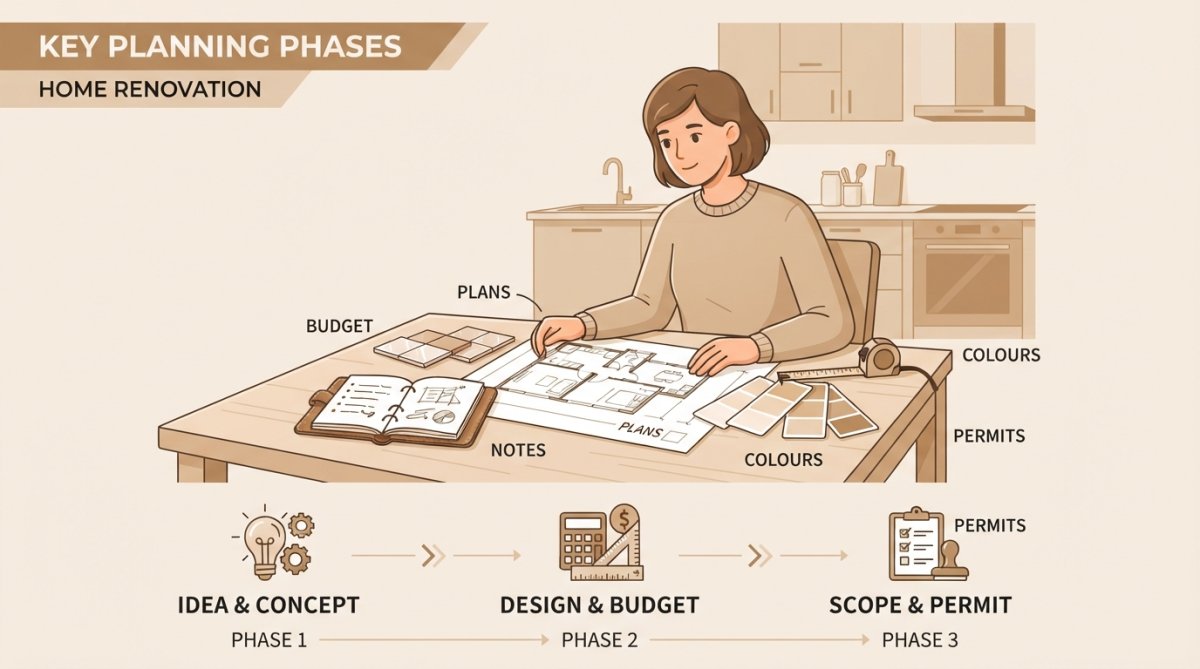
Successful home renovations begin long before the first hammer swings. At White Rock Handyman & Renovations, we’ve guided homeowners across Surrey, South Surrey, White Rock, Langley, Cloverdale, and Delta through hundreds of projects. The smoothest renovations share one common trait: thorough planning. The difference between a stressful renovation and a manageable one comes down to preparation, clear scope definition, securing permits, vetting your contractor, and mentally preparing your household for disruption.
This guide walks you through every phase: financial planning, design decisions, BC-specific legal requirements, contractor vetting, and practical steps to protect your home and family during construction.
Setting a Home Renovation Budget in Canada
Your renovation budget is the foundation of every decision that follows. Most homeowners underestimate costs initially. Material costs, labour rates, and permit fees in the Lower Mainland are higher than many expect, and unexpected structural issues can add thousands to the bill.
Determine what you can afford to spend by reviewing your savings, available credit, and financing options. Once you know your total available funds, allocate roughly 20 percent as a contingency reserve. This is essential, not optional. Break your remaining budget into categories: materials, labour, permits, design consultation, and a small buffer for cost overruns. Labour typically accounts for 40-50 percent of renovation costs.
Understanding Contingency Funds and Unexpected Issues
Contingency funds exist because renovations always uncover surprises. You tear into a wall expecting standard framing and instead find asbestos insulation, outdated wiring, or structural damage from past water intrusion. A 20 percent contingency is standard for renovations where you’ve had a professional inspection. For older homes (pre-1970s), consider 30 percent. When unexpected costs arise, your contractor should document them with photos and written explanation before proceeding.
Financing Options Beyond Basic Budgeting
If your renovation exceeds your available savings, several financing options exist for BC homeowners.
Home Equity Line of Credit (HELOC). You borrow against your home’s equity at a variable interest rate. HELOCs are flexible, you draw what you need, when you need it, and pay interest only on the amount borrowed.
Home Improvement Loan. Banks and credit unions offer fixed-rate loans specifically for renovations with set terms (typically 5-10 years), making budgeting predictable.
Refinancing Your Mortgage. If mortgage rates have dropped, refinancing can free up monthly cash flow for renovation costs.
Contractor Payment Plans. Some contractors, including White Rock Handyman & Renovations, allow staged payments tied to project milestones rather than requiring full payment upfront.
Defining Your Renovation Scope and Design Goals
Scope creep, the gradual expansion of a project beyond its original plan, is one of the most common reasons renovations go over budget and timeline. Define your scope clearly before hiring a contractor. Write down exactly what you’re renovating and what you’re not touching. These boundaries prevent scope creep and help your contractor price the work accurately.
Gathering Inspiration and Creating a Vision
Before meeting with a designer or contractor, gather visual inspiration from online sources, magazines, and homes you visit. Create a mood board showing styles, colours, finishes, and layouts you like. Pay attention to practical details: storage needs, open versus closed cabinetry, natural light preferences, and maintenance tolerance. When you meet with your contractor, bring your mood board and be honest about your lifestyle. The best choice matches how you actually live.
Working with a Designer or Architect
For major renovations involving structural changes, layout reconfiguration, or complex systems, working with a designer or architect is worthwhile. These professionals understand code requirements, spatial planning, and how to maximize functionality. In BC, structural changes and load-bearing wall modifications require engineering, which a designer can coordinate. At White Rock Handyman & Renovations, we work with designers and architects regularly and can recommend professionals we trust.
Home Renovation Permits and Code Compliance in BC
Permits are non-negotiable in BC. Many homeowners skip them to save money or time, but unpermitted work creates serious problems: your home won’t pass inspection when you sell, your insurance may not cover damage from unpermitted work, and you could face fines from your municipality. In Surrey, White Rock, Langley, Cloverdale, and Delta, permit requirements vary slightly, but the principle is the same.
Most kitchen and bathroom renovations require permits. Structural work, electrical upgrades, plumbing changes, and HVAC modifications definitely require permits. Your contractor should clarify what needs permitting and handle the application process. Once issued, a permit comes with scheduled inspections at key stages: framing, electrical rough-in, plumbing rough-in, and final inspection. These inspections ensure work meets the British Columbia Building Code.
Understanding WorkSafeBC Clearance and CGL Insurance Requirements
Before hiring any contractor, verify two critical documents: a WorkSafeBC clearance letter and Commercial General Liability (CGL) insurance.
WorkSafeBC Clearance. This letter confirms that the contractor is registered with WorkSafeBC and has no outstanding violations or unpaid assessments. It’s proof that the contractor is legitimate and follows workplace safety standards. You can request this letter directly from any contractor. If a contractor refuses or says they don’t have one, that’s a red flag. At White Rock Handyman & Renovations, we provide WorkSafeBC clearance letters to every client before work begins.
Commercial General Liability Insurance. CGL insurance protects you if someone is injured on your property or if property damage occurs during the renovation. A contractor without CGL insurance puts you at personal liability risk. CGL insurance typically covers up to $2 million in liability and is standard for licensed contractors. Ask for a certificate of insurance naming you as an additional insured.
These documents aren’t optional. They’re your protection against liability, injury, and financial loss.
Hiring a Contractor in Canada: Vetting and Communication
Your contractor is the person who translates your vision into reality. Hiring the right one is the single most important decision in your renovation.
Start by gathering recommendations from friends and family who’ve done renovations recently. Check online reviews on Google and HomeStars, but read them critically. Interview at least three contractors. Provide each with the same scope document and ask for a detailed quote breaking down labour, materials, permits, and timeline. Red flags include quotes significantly lower than others, vague line items, or refusal to provide a written quote.
Verifying Licensing, Insurance, and Municipal Business Licensing
Before signing anything, verify that your contractor is properly licensed and insured. In BC, contractors need a municipal business license from their city (Surrey, White Rock, Langley, etc.). You can verify this by checking the municipality’s business registry or asking the contractor directly.
Ask for proof of:
- WorkSafeBC registration and clearance letter
- Commercial General Liability insurance (certificate of insurance)
- Municipal business license
- References from recent projects (call at least two)
At White Rock Handyman & Renovations, we’re fully licensed, insured, and bonded. We provide all documentation upfront. Our 37+ years in business and 110+ five-star reviews reflect our commitment to doing things right.
Setting Expectations and Communication Protocols
Before work begins, establish clear communication expectations in writing. Your contract should specify:
- Start and end dates (or timeline milestones)
- Daily work hours
- Where materials will be stored
- How the site will be cleaned daily
- Payment schedule and terms
- Change order process
- Warranty on work completed
- Contact information for the project manager
Clear expectations prevent conflict.
Home Renovation Checklist Canada: Pre-Work Preparation
The week before work begins, prepare your home to protect your belongings, create safe zones, and minimize disruption.
Decluttering, Packing, and Protecting Your Belongings
If your renovation involves a kitchen or bathroom, remove everything from cabinets, drawers, and the space being renovated. Pack items you’ll need during the project into clearly labeled boxes and store them outside the work zone. For items you’re keeping but not using, pack them into bins and store them in a garage, basement, or spare room. During a renovation, dust settles on every surface, so anything in the work zone will need cleaning afterward.
Protect furniture and flooring in adjacent rooms with drop cloths or plastic sheeting. If you have hardwood or tile flooring near the work zone, protect it with plywood or cardboard and tape.
Planning for Dust, Noise, and Site Preparation
Renovations are dusty and loud. Your contractor should use plastic sheeting to seal the work zone from the rest of your home and dust containment equipment (HEPA-filtered vacuums, air scrubbers) to minimize airborne particles. Even with these measures, dust will be present. Close doors to other rooms, seal gaps with weatherstripping, and run HVAC systems to filter air.
Most contractors work between 7 a.m. and 5 p.m., but confirm hours with yours. If you work from home, plan to work elsewhere on demolition days. If you have young children or pets sensitive to noise, brief your contractor and discuss the loudest phases so you can plan around them.
Living in Your Home During Renovation: Strategies for Families and Pets
One of the most underestimated aspects of preparing for a home renovation is managing daily life while work happens. If you’re renovating a kitchen or bathroom, you’re losing access to essential spaces.
Temporary Living Arrangements and Safe Zones
If your renovation involves your primary bathroom, plan for alternatives. Can you use a guest bathroom? If not, consider staying with family or renting temporary accommodation for the duration. For kitchen renovations, plan meals around takeout, meal prep, or eating out.
Create a “safe zone” in your home where your family can retreat. This room should be sealed from the work zone with plastic sheeting and closed doors. Keep it clean, comfortable, and away from dust and noise.
If you have pets, the renovation is disruptive for them too. Noise and unfamiliar people stress animals. Consider boarding pets during the loudest phases, or ensure they have a quiet, secure room away from the work zone. Keep pets’ routines as normal as possible.
Managing Renovation Stress and Emotional Preparation
Renovations are stressful. Your home is disrupted, your routine is disrupted, and there’s noise, dust, and strangers in your space. Many homeowners underestimate the emotional toll.
Prepare mentally by acknowledging that the next weeks or months will be inconvenient. Set realistic expectations about noise, dust, and timeline delays. Delays happen, weather, supply chain issues, unexpected site conditions. If you expect challenges and plan for them, you’ll handle them better. Maintain perspective: the renovation is temporary, but the improved space is permanent. Stay connected with your contractor. Regular communication reduces anxiety.
Creating a Realistic Timeline and Managing the Project
Timeline expectations are where many renovations derail. Homeowners often expect renovations to proceed linearly from start to finish. In reality, timelines are fluid. Weather delays projects. Supply chains cause material shortages. Unexpected site conditions require problem-solving. Subtrades are scheduled around other jobs.
A realistic timeline for a bathroom renovation is 4-8 weeks, depending on scope. A kitchen renovation typically takes 8-12 weeks. These timelines assume no major unexpected issues and that materials are available. If you’re doing structural work or working in an older home where surprises are likely, add buffer time.
Your contract should specify a project timeline with key milestones: demolition complete by week 2, framing and rough-ins by week 4, drywall and finishing by week 6, final touches and inspections by week 8.
Scheduling Subtrades and Coordinating Deliveries
Subtrades, electricians, plumbers, HVAC technicians, tile setters, work in a specific sequence. Electrical rough-in happens before drywall. Plumbing rough-in happens before drywall. Tile setting happens after drywall and before finish work. Your contractor coordinates this sequence. If a subtrade is delayed, the entire timeline shifts.
Material deliveries also affect timeline. Confirm delivery dates with suppliers weeks in advance. At White Rock Handyman & Renovations, we manage the entire coordination, schedule subtrades, track deliveries, and communicate with you about any delays.
|
Preparation Phase |
Key Actions |
Timeline |
|---|---|---|
|
Budget & Financing |
Determine total budget, establish contingency fund (20-30%), explore financing options |
2-4 weeks |
|
Design & Scope |
Define renovation scope, gather inspiration, create mood board, meet with designer if needed |
2-6 weeks |
|
Permits & Compliance |
Determine permit requirements, hire contractor, apply for permits |
2-4 weeks |
|
Contractor Vetting |
Interview contractors, verify licensing/insurance/CGL, check references, sign contract |
2-3 weeks |
|
Home Preparation |
Declutter and pack items, protect furniture and flooring, prepare temporary living arrangements |
1 week before start |
|
Communication Setup |
Establish communication protocols, confirm schedule, brief household on disruption |
1 week before start |
Frequently Asked Questions
What are the first steps to take when planning how to prepare for home renovation in British Columbia?
Start by defining your renovation goals and scope—decide what spaces need work and what outcomes you want. Next, establish a realistic budget and research home renovation permits BC requirements for your project type. Finally, begin vetting contractors early by checking for WorkSafeBC clearance letters, Commercial General Liability insurance, and municipal business licensing in your area (Surrey, White Rock, or elsewhere in the Lower Mainland). Getting detailed quotes from licensed professionals helps ground your planning in reality.
How do I create a realistic home renovation budget Canada that won't blow out halfway through?
Start with material and labour costs for your specific project scope, then add a contingency fund of 15–20% for unexpected issues like hidden structural damage or code upgrades. Research financing options beyond savings—home equity lines of credit, renovation loans, or government rebates may apply. Get multiple quotes from contractors to understand realistic pricing. Document everything in writing, and ensure your contractor provides a detailed quote before work begins. This transparency prevents surprise costs and helps you understand where money goes.
What permits do I need for home renovations in BC, and how do I obtain them?
Permit requirements depend on your project scope. Structural changes, electrical work, plumbing, HVAC updates, and bathroom renovations typically require permits in BC municipalities. Contact your local municipal office (Surrey, White Rock, Langley, etc.) to confirm what applies to your work. Your contractor should handle permit applications as part of their service. Ensure they hold a valid WorkSafeBC clearance letter and Commercial General Liability insurance—these are mandatory for licensed work. Unpermitted work can affect home equity, insurance claims, and resale value.
How do I find a reliable contractor for hiring a contractor Canada and avoid being ghosted or overcharged?
Verify licensing and insurance first—ask for proof of WorkSafeBC clearance, Commercial General Liability coverage, and municipal business licensing. Check online reviews and ask for references you can contact directly. Get detailed written quotes from at least two contractors before deciding. Set clear communication expectations upfront: confirm response times, progress updates, and how changes are handled. A reputable contractor will provide transparent pricing with no hidden fees, stand behind their work with a satisfaction guarantee, and maintain regular contact throughout your project timeline.