
Table of Contents
- Why Hire Insured Contractors for Renovations: Protection You Cannot Afford to Skip
- Understanding Contractor Insurance Requirements in BC
- The Real Risks of Hiring Unlicensed Contractors
- How to Verify WorkSafeBC Clearance and Contractor Status
- Key Steps to Verify an Insured Contractor Before Signing
- Insurance, Bonding, and Your Financial Protection
- Questions to Ask Before Signing a Contract
- Conclusion: Peace of Mind Starts with Due Diligence
Last Updated: July 11, 2026
Why Hire Insured Contractors for Renovations: Protection You Cannot Afford to Skip
Understanding why to hire insured contractors for renovations is essential before signing any agreement with a tradesperson. When a contractor lacks proper insurance coverage, you become personally liable for injuries on your property, property damage claims, and code violations that could compromise your home’s value and your family’s safety. Many homeowners assume lower quotes justify the risk, but that assumption costs families tens of thousands of dollars every year in BC when accidents happen or work fails to meet code requirements.
This guide covers the essential steps to verify WorkSafeBC clearance, understand liability insurance, check references, and spot red flags before you sign a contract.
Understanding Contractor Insurance Requirements in BC
Contractor insurance in British Columbia involves multiple layers of protection, each serving a different purpose.
Commercial General Liability (CGL) Insurance Explained
Commercial General Liability insurance protects you if the contractor causes property damage or bodily injury during the renovation. This policy covers incidents like accidental damage to your home’s structure, injury to a worker or family member, and third-party claims. When a contractor has active CGL coverage, their insurance company, not you, pays for repairs, medical bills, or legal settlements arising from workplace accidents or negligence.
CGL policies typically include coverage limits, usually stated as per-occurrence and aggregate amounts. A contractor working on a kitchen renovation should carry minimum limits of 1 million dollars per occurrence. Without CGL insurance, you’re assuming all liability yourself. If the contractor’s worker falls and breaks a leg, you could be sued directly.
Workers’ Compensation and WorkSafeBC Coverage
WorkSafeBC is the provincial workers’ compensation authority in British Columbia. Every contractor who employs workers must carry WorkSafeBC coverage or hold a valid WorkSafeBC clearance letter stating they operate as a sole proprietor with no employees.
WorkSafeBC coverage protects workers injured on the job, covering medical costs and lost wages without the worker suing the homeowner. If a contractor lacks WorkSafeBC clearance and their worker is injured, you could face a lawsuit from that worker directly.
A WorkSafeBC clearance letter confirms that the contractor has either registered for coverage or is exempt. This letter is valid for a specific period and must be current. To verify WorkSafeBC status independently, you can search the WorkSafeBC registry online using the contractor’s business name or account number.
The Real Risks of Hiring Unlicensed Contractors
Unlicensed and uninsured contractors operate in a legal gray zone that puts your property, finances, and family at risk.
Liability Exposure for Property Damage and Bodily Injury
When an uninsured contractor damages your home during renovations, you have limited recourse. If they cause structural damage, electrical problems, or plumbing failures, their lack of insurance means they have no way to pay for repairs. You’ll either absorb the cost yourself or pursue a lawsuit against them personally, a process that’s expensive and often unsuccessful if the contractor has few assets.
Bodily injury liability is even more serious. If a contractor’s worker is injured on your property and you hired an uninsured contractor, the injured worker can sue you directly. Medical costs for serious injuries can easily exceed 100,000 dollars. Your homeowner’s insurance may refuse to cover the claim if you knowingly hired an uninsured contractor.
Permit and Code Compliance Issues
Unlicensed contractors often skip the permit process to save time and money. This creates two problems: your renovation doesn’t meet BC Building Code requirements, and you have no official inspection to verify the work is safe.
When you later sell your home, a home inspector will likely identify unpermitted work. This can kill a sale or force you to disclose the issue, which significantly reduces your property’s value. Licensed, insured contractors carry the permits required by your municipality to ensure electrical work is safe, structural changes don’t compromise the home, and plumbing meets health standards.
How to Verify WorkSafeBC Clearance and Contractor Status
Verifying a contractor’s credentials takes a few hours of research but prevents months of problems later.
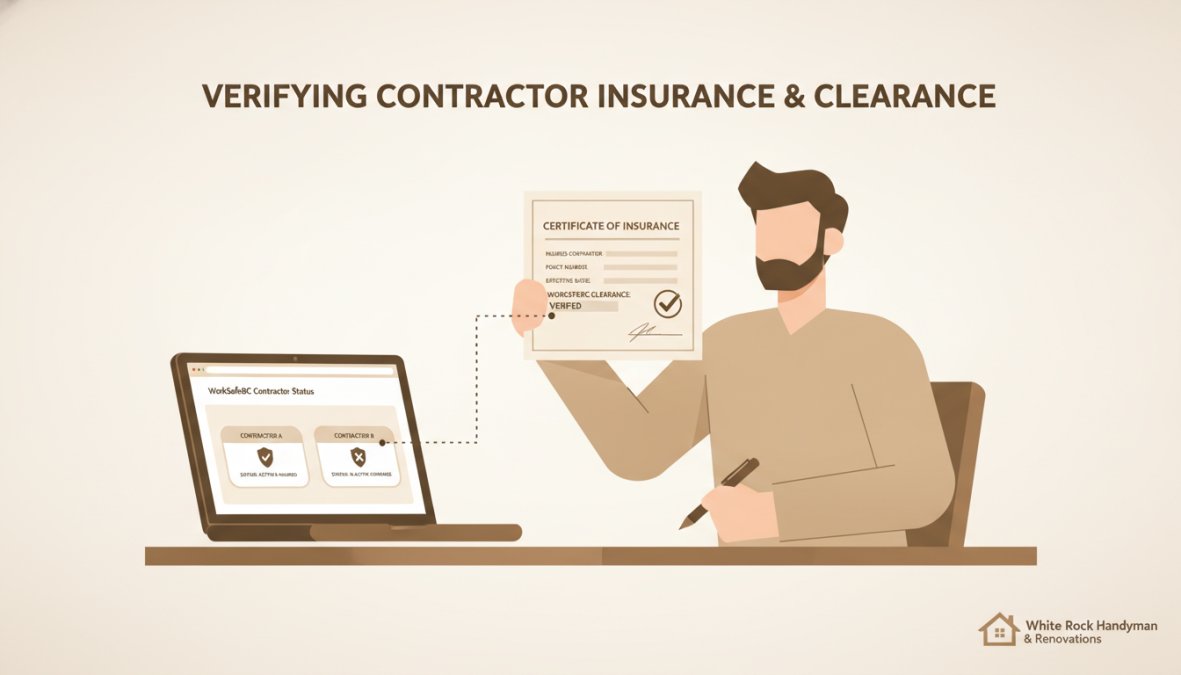
Requesting and Reviewing the Certificate of Insurance (COI)
Ask every contractor for a Certificate of Insurance before you schedule work. When you receive a COI, check these details:
- Policy dates: Confirm the policy is active on the dates you’ll be working.
- Coverage limits: For most residential renovations, minimum coverage should be 1 million dollars per occurrence.
- Your address: The COI should list your property address as a location where work will occur.
- Policy type: Confirm it’s Commercial General Liability (CGL) or equivalent.
If the COI looks suspicious, contact the insurance company directly to verify.
Checking Municipal Business Licensing in Surrey, White Rock, and Surrounding Areas
Every municipality in BC requires contractors to hold a current business license. To verify business licensing, visit your municipality’s website and search for “business license lookup” or “contractor registry,” then enter the contractor’s business name.
Licensed contractors are also more likely to pull the required permits for your project. Unlicensed operators often skip permits to avoid inspection and fees, which exposes you to code violations and liability.
Key Steps to Verify an Insured Contractor Before Signing
Before you sign a contract, conduct a thorough vetting process.
Request Written Estimates and Detailed Project Scope
Always get written estimates from at least three contractors. A written estimate includes the scope of work, materials, timeline, and total cost. A detailed project scope describes exactly what the contractor will do. For example, “Install new kitchen cabinets” is vague; “Remove existing cabinets, patch drywall, install new 42-inch cabinetry with soft-close hinges, and paint surrounding walls” is specific.
Compare estimates side by side. If one estimate is significantly lower than the others, ask why. Lower prices sometimes reflect poor quality, shortcuts, or underestimation of the work required.
Check References and Past Project History
Ask each contractor for at least three references from recent projects. Call those references and ask specific questions: Did the work stay on schedule and within budget? Were there any problems during or after the project? Would you hire this contractor again?
Ask for references from projects similar to yours. A contractor with excellent kitchen renovation experience may struggle with bathroom work.
Red Flags During the Hiring Process
Certain contractor behaviors signal trouble before work even begins:
- Cash-only payments: Contractors who insist on cash often operate without proper accounting, insurance, or licensing.
- No written contract: A legitimate contractor provides a written agreement that outlines scope, timeline, payment schedule, and warranty.
- Pressure to pay upfront: Requests for 50 percent or more upfront are excessive and risky.
- Reluctance to provide insurance or licensing proof: Hesitation suggests they lack proper coverage.
- No physical address or business phone: Contractors operating from a residential address or using only a cell phone may be fly-by-night operations.
- Negative online reviews mentioning disputes or unfinished work: Multiple complaints about the same issues suggest systemic problems.
Insurance, Bonding, and Your Financial Protection
Beyond liability insurance, additional protections exist that safeguard your investment.
Understanding Bonding Status and Lien Waivers
A performance bond is a guarantee from a bonding company that the contractor will complete the work as promised. If the contractor abandons the project or fails to finish, the bonding company pays for completion or reimburses you.
A lien waiver is a document the contractor signs confirming they’ve been paid in full and won’t file a lien against your property. Before making the final payment, always request a lien waiver from the contractor and any major subcontractors.
How Insurance Claims Work When Damage Occurs
If a contractor’s negligence causes damage during your renovation, the claim process begins with notifying the contractor’s insurance company. The insurance company will investigate the damage, determine liability, and either approve or deny the claim.
With a properly insured contractor, their insurance company handles the claim and pays for repairs. You’re protected without involving your own insurance or pursuing legal action.
Questions to Ask Before Signing a Contract
Before signing any renovation contract, ask these questions and confirm the answers in writing:
- What is your current WorkSafeBC clearance status? Ask for a copy of the current clearance letter or registration number.
- What is your Commercial General Liability coverage limit, and does it cover residential work at my address?
- What permits will you pull for this project, and who pays for permit fees?
- What happens if the project runs over budget or schedule?
- What warranty do you provide on labor and materials?
- Will you provide a lien waiver when the project is complete?
- What is your payment schedule?
- How will you handle disputes or problems during the project?
- Are you licensed with the municipality, and what is your business license number?
- Can you provide three references from similar projects completed in the last two years?
|
Question |
Why It Matters |
Red Flag If… |
|---|---|---|
|
WorkSafeBC clearance status |
Protects you from worker injury liability |
Contractor hesitates or provides outdated clearance |
|
CGL coverage limits and scope |
Confirms you’re covered for property damage and bodily injury |
Limits are below 1 million or policy excludes residential work |
|
Permits and fees |
Ensures work meets code and your property is protected |
Contractor suggests skipping permits to save money |
|
Budget and schedule changes |
Prevents scope creep and surprise costs |
No written process for approving changes |
|
Warranty terms |
Defines your recourse if work fails |
Contractor offers no warranty or refuses to put it in writing |
|
Lien waiver |
Prevents liens against your property after payment |
Contractor refuses or says it’s unnecessary |
Conclusion: Peace of Mind Starts with Due Diligence
Hiring a contractor without verifying insurance, licensing, and WorkSafeBC clearance is like driving without a seatbelt. The few hours you invest in vetting a contractor now prevent thousands of dollars in liability, code violations, and unfinished work later.
White Rock Handyman & Renovations brings over 37 years of industry experience, full licensing, current insurance, and WorkSafeBC clearance to every project. The team provides detailed written estimates with no call-out fees and completes all work to code requirements.
Frequently Asked Questions
What happens if an uninsured contractor gets hurt on my property in BC?
If an uninsured contractor is injured on your property, you may be held personally liable for medical expenses and lost wages—even if the contractor was negligent. Your homeowner's insurance typically does not cover injuries to uninsured contractors. This can result in significant out-of-pocket costs and legal action. Hiring an insured contractor with proper WorkSafeBC coverage protects you from this liability exposure.
How do I verify a contractor's WorkSafeBC clearance letter in BC?
Request a current WorkSafeBC clearance letter directly from the contractor. You can also verify their status online through WorkSafeBC's registry. Ask for a Certificate of Insurance (COI) showing active coverage. Confirm the contractor holds a valid municipal business license for their area (e.g., Surrey, White Rock, or Langley). Never proceed without written proof of all three.
What is Commercial General Liability (CGL) insurance for home renovations?
CGL insurance covers property damage and bodily injury caused by the contractor's work. It protects you if the contractor accidentally damages your home, fixtures, or neighbouring properties, or if someone is injured during the project. The policy should clearly list your address as the project location and include adequate coverage limits for your renovation scope.
Are municipal business licenses required for contractors in Surrey and White Rock?
Yes. Both Surrey and White Rock require contractors to hold valid municipal business licenses. This is a legal requirement, not optional. Verify the contractor's license status with the municipality before hiring. A licensed contractor demonstrates they meet local bylaws, safety standards, and permit requirements for home renovations in your area.