
Table of Contents
- DIY vs Professional Home Repairs: Cost Comparison & Hidden Risks
- Common DIY Home Improvement Mistakes That Cost More Than Professional Work
- Home Renovation Permits in BC: Why Professional Compliance Matters
- Cost of Handyman Services in BC: What You’re Actually Paying For
- Benefits of Professional Contractors: Beyond the Price Tag
- When to Hire a Professional vs DIY: Decision Framework
- Conclusion: Making the Right Choice for Your Lower Mainland Home
Last Updated: August 1, 2026
DIY vs Professional Home Repairs: Cost Comparison & Hidden Risks
When facing a leaky tap, cracked drywall, or an outdated kitchen, the first question is often “Can I do this myself?” At White Rock Handyman & Renovations, we’ve spent over 37 years watching homeowners across Surrey, South Surrey, White Rock, Langley, Cloverdale, and Delta wrestle with this decision. The uncomfortable truth: sometimes the cheapest option costs you the most. A $200 DIY plumbing repair that ruptures a water line can become a $15,000 water damage claim. A $50 electrical fix that doesn’t meet code can void your home insurance or trigger expensive inspections before sale.
Understanding the True Cost of DIY
The sticker price of a DIY project tells you almost nothing about its actual cost. Beyond materials, you’re committing to tools, time, and failure risk.
Tool costs add up quickly. A basic drywall repair might need a drywall saw, joint compound, sanding block, and primer. Renting tools ranges from $50-100 per project. Accumulate three or four projects, and you’re looking at $300-500 in rental fees. Purchasing tools instead means investing $800-2,000 in equipment that sits unused between projects.
Time is the hidden cost. A job taking a licensed contractor 4 hours might consume your entire weekend, 16 hours of your time. At an effective hourly rate of $35, that’s $560 in opportunity cost, plus materials and stress.
The real danger emerges when something goes wrong. A misaligned door frame causes structural stress over time. Improper electrical work fails catastrophically. A plumbing mistake leaks inside walls where damage accumulates unseen. Professional contractors carry Commercial General Liability (CGL) insurance covering these failures. You don’t.
What Professional Labour Actually Costs in BC
Professional labour in British Columbia reflects the contractor’s experience, insurance, licensing, and liability exposure. A handyman or renovation professional in the Lower Mainland charges for several things beyond visible work.
First, there’s the licensing and insurance infrastructure. In British Columbia, contractors must carry WorkSafeBC clearance letters and Commercial General Liability (CGL) insurance. Municipal business licensing, whether in Surrey, White Rock, Langley, or other Lower Mainland communities, adds compliance costs. These protect you: if a licensed, insured contractor damages your home, their insurance covers it. An unlicensed handyman leaves you fighting for reimbursement from personal assets.
Second, there’s expertise. A professional has completed hundreds of similar projects. They know which materials last, which shortcuts cause future problems, and how to avoid costly mistakes. They work faster because they’ve done it before.
Third, labour rates reflect the cost of doing business. These rates include overhead: vehicle maintenance, insurance premiums, tools and equipment, administrative costs, and the reality that not every available hour translates to billable work.
The key insight: professional labour costs more per hour, but the job finishes faster and carries a warranty. A contractor who installs a kitchen faucet guarantees the work for a year. If it leaks, they fix it free. A DIY installation comes with no guarantee.
Common DIY Home Improvement Mistakes That Cost More Than Professional Work
Structural damage and code violations represent the most expensive category of DIY failures. A homeowner who removes a load-bearing wall without proper support can cause foundation settlement costing $30,000-50,000 to correct. A drywall installation that doesn’t follow fire code can void your home insurance or cover on that room.
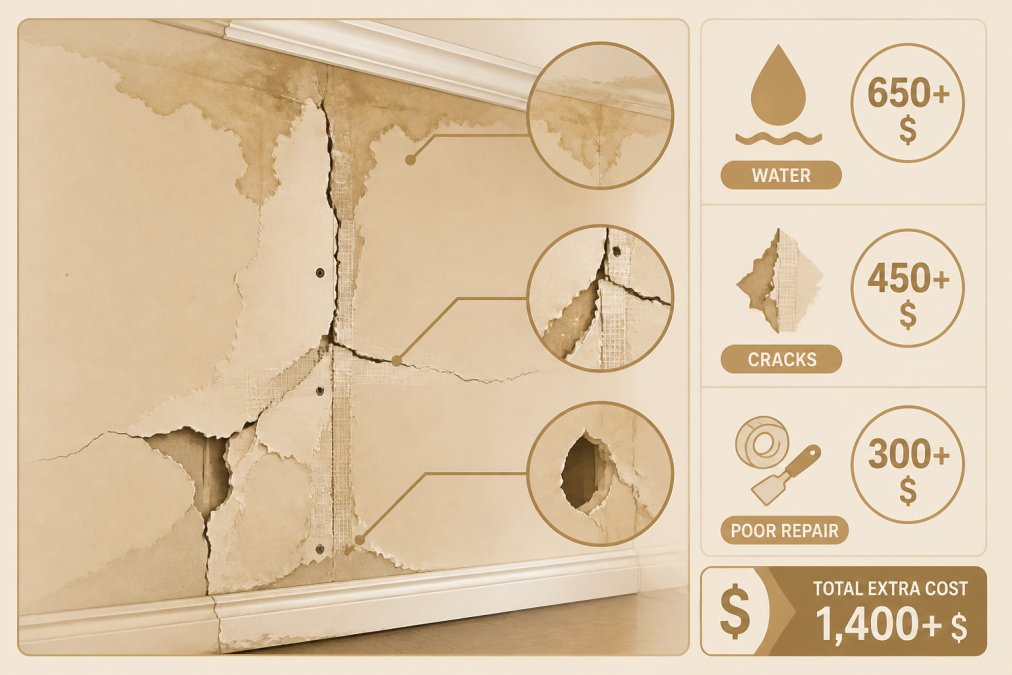
Structural Damage & Code Violations
Building codes exist because buildings that don’t follow them fail structurally, electrically, or catastrophically. A common mistake: removing a wall to open a kitchen without installing a beam to carry the load above. For 6-12 months everything seems fine. Then cracks appear in the ceiling. The floor sags. A structural engineer’s assessment costs $1,500-2,500. The correction, installing a properly sized beam with support posts, costs $8,000-15,000. The homeowner has now spent $10,000-18,000 to fix a mistake that a licensed contractor would have avoided with a permit and structural engineer’s sign-off.
Code violations remain invisible until you try to sell your home or file an insurance claim. A bathroom renovation that doesn’t include proper ventilation code compliance might pass your eye test but fail a home inspection. The buyer’s inspector flags it. The sale stalls. You hire a contractor to bring it to code.
Safety Hazards in Electrical & Plumbing Work
Electrical work carries immediate and long-term safety risks. A homeowner who installs a new outlet on an existing circuit might exceed the circuit’s capacity. The system doesn’t fail immediately; it overheats. Months later, a fire starts inside the wall. Insurance investigators discover unlicensed electrical work. Your claim is denied.
Plumbing mistakes create slow, hidden damage. A connection that isn’t quite sealed weeps. Water accumulates inside walls. Mold develops. Framing rots. By the time damage becomes obvious, remediation, removing walls, replacing framing, treating mold, costs $10,000-25,000.
Professional plumbers and electricians are licensed because these trades kill people and destroy homes when done wrong.
The Cost of Failure Calculator: When Mistakes Become Expensive
Here’s a practical framework for evaluating whether a DIY project makes financial sense:
Total DIY Cost = Materials + Tool Rental/Purchase + (Your Time × Your Hourly Rate) + (Probability of Failure × Cost of Failure)
For a bathroom vanity installation:
- Materials: $300
- Tool rental: $0-50
- Your time: 6 hours × $40/hour = $240
- Probability of failure: 15% (water leak, improper installation)
- Cost of failure: $3,000 (water damage, mold remediation)
- Failure cost weighted: 0.15 × $3,000 = $450
Total DIY cost: $990
A licensed plumber charges $800 labour + $300 materials = $1,100. The DIY option seems cheaper by $110. But if the probability of failure is actually 25%, the weighted failure cost becomes $750. Total DIY cost jumps to $1,290, now the professional is cheaper and carries a warranty.
For structural work, electrical, or plumbing, the probability of failure is high enough that the expected cost of DIY almost always exceeds professional pricing.
Home Renovation Permits in BC: Why Professional Compliance Matters
Permits exist because buildings that aren’t built to code fail structurally, electrically, or in ways that kill people or destroy homes. In British Columbia, permits are required for most renovations, and skipping the permit process creates legal and financial liability.
When Permits Are Required for Home Repairs
In BC, permits are required for structural modifications, electrical work beyond simple outlet replacement, plumbing installations, HVAC modifications, bathroom and kitchen renovations, additions or major alterations, and roof work or structural repairs.
The threshold varies by municipality. In Surrey, White Rock, Langley, and other Lower Mainland communities, most renovations over $5,000 in value require permits. Some municipalities require permits for smaller projects.
A homeowner who skips permits saves $300-800 on permit fees and inspections. They also create a liability that follows them forever. When selling, a home inspector discovers unpermitted work. The buyer’s lender refuses to finance until the work is brought to code or removed. The sale falls through or the seller must pay for correction. Unpermitted work can reduce home value by 5-15% and makes the property unsellable to buyers using mortgage financing.
WorkSafeBC Clearance & Municipal Business Licensing
Licensed contractors in BC carry WorkSafeBC clearance letters proving compliance with workplace safety regulations. They maintain municipal business licenses in the communities where they operate. These aren’t just paperwork; they’re proof that the contractor is insured, bonded, and accountable.
When you hire a licensed contractor like White Rock Handyman & Renovations, you’re hiring someone with skin in the game. If they do shoddy work, their license is at risk. Their insurance can be cancelled. Their business reputation suffers. An unlicensed handyman has none of these incentives.
Cost of Handyman Services in BC: What You’re Actually Paying For
Professional handyman services in British Columbia are priced to cover labour, expertise, insurance, and accountability. Understanding what you’re paying for explains why professional work costs what it does.
Labour Costs vs Material Costs Breakdown
For most home repairs, labour represents 60-75% of the total cost. Materials are 25-40%. A bathroom sink replacement might break down as $650 labour and $350 materials.
This ratio reveals where DIY saves money and where it doesn’t. On projects where materials are cheap but labour is high (like painting), DIY saves real money. On projects where materials are expensive and labour is low (like replacing a water heater), DIY saves less. On projects requiring specialized skills or tools (electrical, plumbing, structural), the labour cost reflects the contractor’s expertise and liability exposure.
A licensed contractor’s labour rate includes wages (typically 40-50% of the labour charge), insurance and licensing (10-15%), vehicle, tools, and equipment (10-15%), administrative overhead (10-15%), and profit margin (10-20%).
Tool Rental vs Purchase Economics for DIY Projects
The tool investment decision hinges on frequency of use. A tool you’ll use once every five years should be rented. A tool you’ll use quarterly should be purchased.
For a one-time project, rental is economical. For someone regularly undertaking landscaping or concrete work, purchase becomes cost-effective after 3-4 rental cycles.
The hidden cost of tool ownership is storage and maintenance. A purchased tool sits in your garage until the next project. Professional contractors use their tools constantly, spreading the ownership cost across many jobs. For homeowners, the per-use cost of ownership is usually higher than rental.
Benefits of Professional Contractors: Beyond the Price Tag
Professional work delivers value that extends far beyond task completion. The real benefits emerge over time.
Insurance Coverage & Liability Protection
When a licensed, insured contractor works on your home, their Commercial General Liability (CGL) insurance covers damage they cause. If they accidentally damage your flooring while installing new cabinets, their insurance pays for correction. If a plumbing mistake causes water damage, their insurance covers it.
When a homeowner causes the same damage, their homeowner’s insurance may deny the claim if the work wasn’t done by a licensed professional. You’re liable for the full cost.
Professional work also protects your home insurance going forward. If an insurer discovers unpermitted electrical work or code violations, they can cancel your policy or exclude those systems from coverage. Professional work, by definition, is permitted and code-compliant.
Warranty, Code Compliance & Resale Value Impact
Professional contractors stand behind their work with warranties. White Rock Handyman & Renovations guarantees satisfaction on every project. If a faucet leaks within a year, it’s repaired at no cost. If drywall work cracks prematurely, it’s corrected. The warranty is insurance against failure.
DIY work comes with no warranty. When it fails, you’re paying again for materials, tools, and potentially professional correction.
Code compliance affects resale value directly. A home with permitted, code-compliant renovations appraises higher and sells faster. A home with unpermitted work appraises lower and sits on the market longer.
When to Hire a Professional vs DIY: Decision Framework
The decision between DIY and professional work should be based on skill, risk, and true cost, not just the hourly rate.
Project Scope, Skill Level & Time Investment
Ask yourself three questions:
- Do I have the skill to do this safely and to code? If the answer is “I’ll learn from YouTube,” the answer is actually “no” for anything beyond basic tasks.
- What’s the cost of failure? For painting or landscaping, failure is cosmetic. You can redo it. For electrical, plumbing, or structural work, failure causes property damage or safety hazards.
- Do I have the time? A professional completes the work in days. You might need weeks of evenings and weekends.
For most homeowners in the Lower Mainland, the honest answer is: hire a professional for anything involving structure, electricity, plumbing, or code compliance. DIY makes sense for painting, simple landscaping, basic carpentry, and cosmetic repairs.
Small Repairs vs Major Renovations: Where Professionals Deliver Real Value
Small repairs, a leaky tap, squeaky door, clogged drain, can sometimes be DIY projects if you have basic skills. The cost of failure is low. The time investment is short. The risk is minimal.
Major renovations, kitchens, bathrooms, additions, structural changes, should always be professional. The complexity is high. The cost of failure is catastrophic. Code compliance is mandatory. The resale value impact is significant.
The grey zone is medium projects: replacing flooring, painting an entire room, installing new fixtures, minor plumbing or electrical work. If you have relevant experience, the tools, the time, and a realistic assessment of failure risk, DIY can work. If you’re learning as you go, hire a professional.
|
Project Type |
DIY Viability |
Time Required |
Failure Risk |
Best Approach |
|---|---|---|---|---|
|
Painting |
High |
2-4 days |
Low (cosmetic) |
DIY if experienced |
|
Drywall patching |
Medium |
4-8 hours |
Low (cosmetic) |
DIY for small areas |
|
Plumbing (simple) |
Low |
2-6 hours |
High (water damage) |
Professional |
|
Electrical (simple) |
Low |
1-3 hours |
High (fire/shock) |
Professional |
|
Flooring |
Medium |
3-7 days |
Medium (structural) |
Professional for large areas |
|
Kitchen renovation |
Very Low |
2-4 weeks |
Very High (code, structure) |
Professional |
|
Bathroom renovation |
Very Low |
1-3 weeks |
Very High (code, plumbing) |
Professional |
|
Roof repair |
Very Low |
1-3 days |
Very High (safety, structure) |
Professional |
The DIY versus professional home repairs cost decision ultimately comes down to risk, expertise, and true cost. A $200 DIY project that fails becomes a $5,000 professional correction. A professional installation comes with a warranty and code compliance. For homeowners across the Lower Mainland, whether in Surrey, White Rock, Langley, or surrounding communities, the safest and most cost-effective approach is clear: handle cosmetic repairs yourself if you have the skills, and hire licensed professionals for anything structural, electrical, plumbing, or code-dependent. Contact White Rock Handyman & Renovations for a free estimate to understand the true professional cost for your specific project, and make an informed decision based on real numbers, not assumptions.
Frequently Asked Questions
What home repairs are best left to professionals in British Columbia?
Electrical work, plumbing repairs, structural modifications, and any project requiring building permits should be handled by licensed professionals. In BC, unpermitted work can affect your home insurance coverage and resale value. Professional contractors carry Commercial General Liability (CGL) insurance and WorkSafeBC clearance, protecting you from liability if something goes wrong. Bathroom and kitchen renovations, HVAC maintenance, and load-bearing wall changes are also best left to experienced professionals to ensure code compliance.
How much can I save by doing DIY home repairs versus hiring a professional in BC?
While DIY eliminates labour costs, savings are often offset by tool purchases or rentals, material waste, and time investment. A failed DIY repair—such as improper plumbing that causes water damage—can cost thousands more than professional work would have. Tool rental through Home Depot or RONA ranges from $69 for 4-hour rentals to weekly rates, but specialized equipment adds up quickly. The real savings come from hiring professionals for complex work where mistakes carry high financial and safety consequences.
What are the risks of DIY home repairs in BC, and how do they affect my home insurance?
DIY mistakes can create safety hazards, code violations, and structural damage that voids insurance claims. Unpermitted electrical or plumbing work may result in your insurer denying coverage if damage occurs. Licensed professionals carry CGL insurance and maintain WorkSafeBC clearance, protecting you legally. Additionally, poor-quality DIY work reduces resale value and can trigger expensive inspections during a home sale. Safety risks in electrical and plumbing work are particularly serious—improper installation can lead to fires, electrocution, or water damage.
When do I need a permit for home renovations or repairs in British Columbia?
Most municipalities in the Lower Mainland—including Surrey, White Rock, and Langley—require permits for electrical work, plumbing changes, structural modifications, and kitchen or bathroom renovations. Minor repairs like painting or replacing fixtures typically don't need permits, but it's wise to check with your local municipal business licensing office. Professional contractors handle permit applications and inspections, ensuring your work meets building code requirements. Unpermitted work can complicate future sales and may result in fines or forced removal of the work.
What should I look for in a professional contractor or handyman in the Lower Mainland?
Verify that contractors hold current municipal business licensing in your area (Surrey, White Rock, Langley, etc.), carry Commercial General Liability (CGL) insurance, and possess WorkSafeBC clearance letters. Ask for detailed written quotes before work begins, and confirm they guarantee satisfaction with no hidden fees. Experience matters—contractors with 37+ years in the industry understand local building codes and avoid costly mistakes. Check for transparent pricing, no call-out fees for estimates, and references from previous customers in your community.