
Table of Contents
- Understanding Hidden Costs in Home Renovations
- Structural Issues and Unexpected Discoveries
- Home Renovation Permits and Compliance in White Rock
- Material Price Fluctuations and Labour Overruns
- Building a Renovation Contingency Fund for Canada
- Creating a Renovation Contract Checklist for BC Homeowners
- Waste Removal, Temporary Living, and Hidden Expenses
- Avoiding Hidden Costs Through Contractor Due Diligence
Last Updated: July 26, 2026
Understanding Hidden Costs in Home Renovations
Avoiding hidden costs in home renovations is critical before breaking ground. At White Rock Handyman & Renovations, we’ve helped hundreds of homeowners across Surrey, South Surrey, White Rock, Langley, Cloverdale, and Delta navigate renovation budgets without unexpected expenses. Most renovations that exceed budget fail because homeowners and contractors underestimate what “complete” actually means.
The moment a contractor opens a wall or lifts flooring, the scope often expands. What looked like a simple refresh becomes structural remediation. What should have been two weeks stretches into two months. What was budgeted at one figure suddenly balloons by 30%, 50%, or more.
The difference between a renovation that stays on budget and one that spirals comes down to anticipation. Knowing where hidden costs hide, building contingency into your planning, and choosing contractors who communicate transparently about discoveries, these practices separate successful renovations from financial disasters.
Structural Issues and Unexpected Discoveries
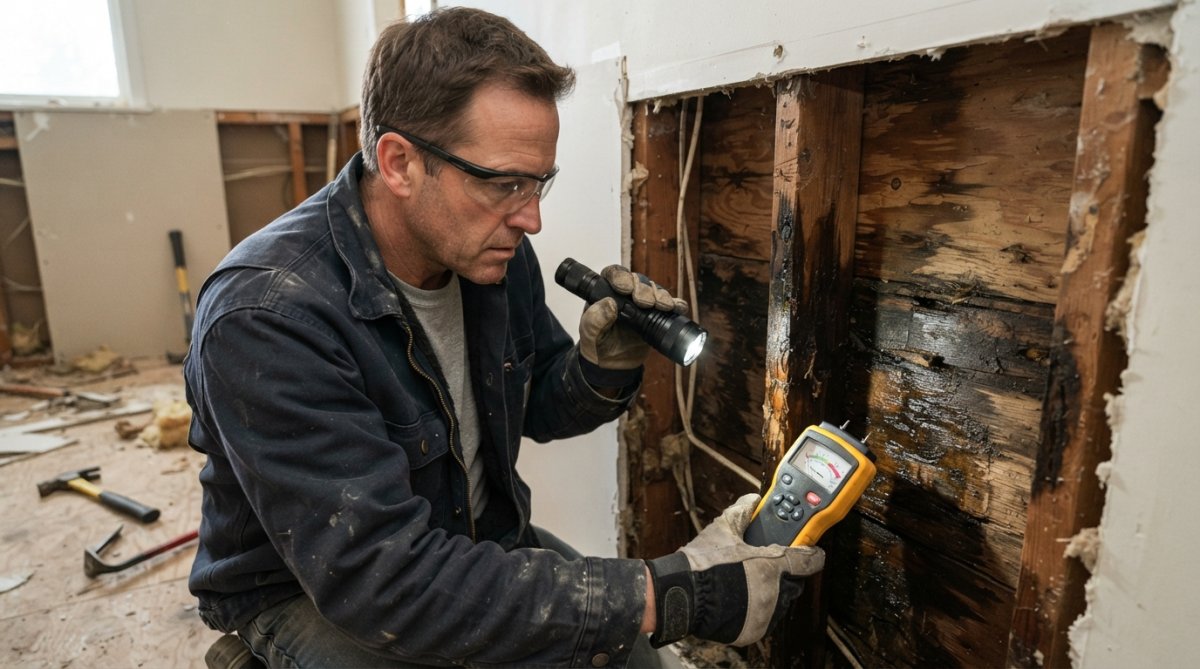
The moment you open a wall in a home built before 1990, you’re gambling. Behind that drywall could be outdated wiring needing complete replacement, failing plumbing, mold colonies, or structural damage spreading silently. These discoveries are inevitable in older homes. Structural issues represent the single largest category of hidden costs in renovations. Unlike material price fluctuations or labour overruns, structural problems are binary: they exist or they don’t. If they exist, they must be addressed.
Mold, Water Damage, and Rot
Water damage is the silent killer of renovation budgets. A small water stain on a basement wall often signals far more extensive damage behind the surface. Mold thrives in damp environments and spreads through insulation, framing, and structural members. Rot follows the same pattern, wood that appears solid may be compromised deep within.
Homeowners can’t see these problems until walls are open. A visual inspection tells you almost nothing. By the time demolition reveals the full extent, you’re committed. The wall is open, the problem is exposed, and it must be fixed before proceeding.
At White Rock Handyman & Renovations, we’ve encountered mold and water damage in approximately 40% of renovation projects involving basements or below-grade spaces. Remediation typically requires professional mould assessment, removal by certified contractors, replacement of affected materials, and moisture control solutions. These costs are non-negotiable and often substantial.
Outdated Wiring and Plumbing
Homes built in the 1970s and 1980s frequently contain knob-and-tube wiring or aluminum wiring, both presenting fire hazards and violating modern electrical codes. Plumbing systems from the same era often used galvanized steel or cast iron, which corrode over time and restrict water flow. These systems don’t just fail, they fail in ways that cause secondary damage.
When you discover that a home’s electrical system doesn’t meet code, you face a choice: leave it as-is (which no reputable contractor will do) or upgrade it. Upgrading means new wiring throughout affected areas, new panels, new breakers, and new outlets. It means walls open longer, more labour, and more expense.
The same applies to plumbing. Corroded pipes leak, contaminate water, and fail during renovation work, forcing emergency repairs and timeline delays.
Home Renovation Permits and Compliance in White Rock
In British Columbia, most renovations require permits. Rules vary by municipality, White Rock has different requirements than Surrey, which differs from Langley, but the principle is consistent: any work affecting structure, electrical systems, plumbing, or HVAC requires municipal approval and inspection.
Permits ensure work meets building codes, protects public safety, and maintains property standards. They also add time and cost to your project. Permit fees vary by scope and location. Inspections require scheduling and can delay your timeline if work doesn’t pass on the first review. Unpermitted work discovered later creates serious problems for selling your home or obtaining insurance coverage.
Municipal Licensing and Code Requirements
White Rock, like all Lower Mainland municipalities, requires contractors to hold current business licenses and maintain specific insurance coverage. Before any contractor begins work on your property, verify three things: their municipal business license, their WorkSafeBC clearance letter, and their Commercial General Liability (CGL) insurance.
A WorkSafeBC clearance letter confirms that the contractor is registered with WorkSafeBC and has no outstanding safety violations. This is a legal requirement in British Columbia. Any contractor who cannot produce this documentation is operating outside the law, and you become liable if someone is injured on your property.
CGL insurance protects you if a contractor damages your home or someone is injured during work. A contractor without CGL insurance is a financial risk. At White Rock Handyman & Renovations, we maintain full CGL coverage and carry WorkSafeBC clearance. These are basic requirements for professional, legal operation.
Building codes in British Columbia are detailed and specific, governing everything from electrical outlet spacing to bathroom ventilation to structural framing. When a contractor discovers that existing work doesn’t meet code, it must be brought into compliance. This often means removing and redoing work, which costs time and money.
Material Price Fluctuations and Labour Overruns
Material costs fluctuate. Lumber prices spike when demand increases. Copper prices rise with global commodity markets. Bathroom fixtures and kitchen cabinets are manufactured globally, and supply chain disruptions translate directly into price increases and delivery delays.
Labour costs are more predictable in some ways, less in others. You can estimate how many hours a task should take. But when a contractor opens a wall and discovers problems, the estimate becomes irrelevant. The work takes longer. Additional labour is required. The timeline extends.
Managing Scope Creep and Design Changes
Scope creep is the slow expansion of a project beyond its original definition. It starts innocently: “While you’re in there, could you also…” Each small addition seems minor. Collectively, they transform the project.
Design changes operate similarly. A homeowner decides mid-project that they want a different tile, fixture, or layout. Each change requires new materials, potentially new labour, and often timeline adjustments.
The best protection against scope creep and design changes is clarity. Before work begins, the scope must be defined in writing. The design must be finalized. Change orders must be in place, a formal process for requesting changes, documenting their cost impact, and getting written approval before proceeding.
At White Rock Handyman & Renovations, we provide detailed quotes that itemize every aspect of the work. When changes are requested, we document them formally and discuss cost impacts before proceeding.
Building a Renovation Contingency Fund for Canada
A contingency fund is your financial buffer for the unexpected. It’s not pessimism, it’s realism. Unexpected discoveries in renovation work are guaranteed. The only variable is how much they’ll cost.
Industry practice suggests a contingency fund of 10-20% of the total project budget. For a $50,000 renovation, that means $5,000 to $10,000 held in reserve. For a $100,000 project, $10,000 to $20,000. This isn’t money you hope to spend, it’s money you set aside specifically for discoveries.
The contingency fund prevents project delays caused by budget constraints. When mold is discovered, the work doesn’t stop while you scramble for financing. It reduces stress and gives the contractor flexibility to address problems properly rather than looking for cost-cutting shortcuts.
Without a contingency fund, homeowners often face impossible choices: proceed with work that doesn’t meet code, delay the project while financing is arranged, or accept a lower quality solution to stay within budget. A properly funded contingency eliminates these dilemmas.
Creating a Renovation Contract Checklist for BC Homeowners
A solid renovation contract is your primary protection against hidden costs and scope creep. It should clearly define the work, the timeline, the payment schedule, and the process for handling changes and unexpected discoveries.
Your contract should include:
- A detailed scope of work describing exactly what will and will not be done
- A fixed price for the work (or a clear breakdown of hourly rates if hourly billing is used)
- A timeline with start and completion dates
- A payment schedule tied to milestones
- A change order process requiring written approval before any work outside the original scope is performed
- A process for handling unexpected discoveries (how costs will be determined, who approves them)
- A warranty on workmanship (typically one year for labour, longer for materials)
- Insurance and licensing verification (proof of CGL insurance, WorkSafeBC clearance, municipal business license)
- A dispute resolution process
WorkSafeBC Clearance and Insurance Requirements
Before signing a contract, verify the contractor’s WorkSafeBC clearance letter. Request it in writing, a legitimate contractor will provide it without hesitation.
Verify their CGL insurance coverage. Ask for a certificate of insurance naming you as an additional insured. This protects you if the contractor causes damage or someone is injured.
Confirm their municipal business license. In White Rock, contractors must be licensed with the municipality. Verify this through the White Rock municipal office.
These requirements aren’t bureaucratic obstacles, they’re your legal protections. A contractor who won’t provide these documents is a red flag.
Waste Removal, Temporary Living, and Hidden Expenses
Renovation projects generate waste: old materials, packaging, debris. Disposing of this waste costs money. Dumpster rental, hauling fees, and landfill costs add up quickly. A full kitchen renovation might generate 10-15 cubic metres of waste.
Some contractors include waste removal in their quote. Others charge separately. Make sure your contract specifies who’s responsible for waste removal and whether it’s included in the quoted price.
Temporary living arrangements are often overlooked in budgeting. If your kitchen is non-functional for three weeks, you’re eating out or buying prepared food. If your only bathroom is being renovated, you might need to stay elsewhere. For major renovations, consider budgeting for temporary accommodation. For smaller projects, budget for increased food costs during the renovation period.
Avoiding Hidden Costs Through Contractor Due Diligence
Choosing the right contractor is the single most important decision in any renovation. The right contractor communicates clearly, identifies problems early, works within budget, and delivers quality work.
Start by checking WorkSafeBC clearance and CGL insurance. Request references from recent projects and contact them. Ask specific questions: Did the project stay on budget? Were there unexpected costs? How did the contractor handle them? Would you hire them again?
Ask the contractor about their process for handling unexpected discoveries. How do they identify problems? How do they communicate them to homeowners? How do they determine costs? A contractor with a clear, documented process is more reliable than one who says “we’ll figure it out when we get there.”
Request a detailed, itemized quote. A vague quote is a red flag. A detailed quote that breaks down labour, materials, permits, and contingencies demonstrates professionalism and clarity.
Fixed-Price Contracts and Change Orders
A fixed-price contract specifies an exact price for the work. This protects both the homeowner and the contractor. The homeowner knows the maximum cost (barring changes or unforeseen issues). The contractor knows the scope and can plan accordingly.
However, fixed-price contracts require clear scope definition. If the scope is vague, the contractor will either pad the price to cover unknowns or underbid and lose money.
A change order is a formal request to modify the work outside the original scope. It should specify exactly what’s changing, the cost impact, and the timeline impact. Both parties sign it before work proceeds.
When unexpected discoveries occur, mold, structural damage, code violations, the contractor should document the issue, explain why it must be addressed, specify the cost, and get your written approval before proceeding.
|
Element |
Purpose |
Protects |
|---|---|---|
|
Detailed scope of work |
Defines exactly what will and won’t be done |
Both parties |
|
Fixed price or rate |
Establishes financial expectations |
Homeowner from surprise costs |
|
Timeline |
Sets start and completion dates |
Both parties from delays |
|
Change order process |
Formalizes scope modifications |
Both parties from disputes |
|
Insurance verification |
Confirms coverage and liability protection |
Homeowner from uninsured risks |
|
Payment schedule |
Ties payments to milestones |
Contractor from non-payment |
Avoiding hidden costs in home renovations requires anticipation, documentation, and the right contractor. At White Rock Handyman & Renovations, we’ve spent over 37 years helping Lower Mainland homeowners navigate renovation budgets successfully. We provide detailed quotes upfront, maintain full WorkSafeBC clearance and CGL insurance, and communicate transparently about what we find and what it costs. When you’re ready to start your renovation with a contractor who prioritizes clarity and quality, get a free estimate from White Rock Handyman & Renovations, no call-out fees, no surprises.
Frequently Asked Questions
What are the most common hidden costs in BC home renovations?
The most common hidden costs in home renovations include structural issues like mold, water damage, and rot discovered during demolition; permit and zoning fees; material price fluctuations; labour overruns; and waste disposal costs. Many homeowners also encounter unexpected utility upgrades, temporary living expenses, and design changes that increase project scope. Working with a licensed, insured contractor who provides detailed quotes and thorough pre-construction inspections helps identify these risks early and prevents budget overruns.
How much should I budget for a renovation contingency fund in Canada?
A renovation contingency fund should typically represent 15–20% of your total project budget to cover unforeseen structural issues, material price fluctuations, and labour overruns. For example, if your renovation budget is $50,000, set aside $7,500–$10,000 as a buffer. This contingency fund is critical for managing unexpected discoveries like hidden plumbing or electrical problems. A detailed quote and inspection from the outset can help you estimate a more accurate contingency amount based on your home's condition and renovation scope.
What permits and WorkSafeBC clearance do I need for home renovations in White Rock?
Most bathroom, kitchen, and structural renovations in White Rock require municipal building permits and code compliance inspections. Your contractor should handle permit applications and ensure all work meets British Columbia building codes. If your contractor employs workers, they must carry a valid WorkSafeBC clearance letter and Commercial General Liability (CGL) insurance. Always request proof of WorkSafeBC clearance and municipal business licensing before hiring. Failing to obtain proper permits can result in fines, insurance denial, and difficulty selling your home.
What should a renovation contract checklist include in BC?
Your renovation contract checklist should include: a detailed scope of work, fixed-price estimates or hourly rates, payment schedule, timeline with start and completion dates, change order procedures, warranty terms, proof of WorkSafeBC clearance and CGL insurance, municipal business licensing, and a dispute resolution process. The contract should specify which party covers permit fees, waste removal, and temporary living expenses. Require detailed quotes before work begins and ensure all changes are documented in writing. A comprehensive contract protects both you and your contractor and prevents misunderstandings that lead to budget overruns.