
Table of Contents
- What Full Service Home Renovation Contractors Do
- Types of Renovation Services Offered by Full Service Contractors
- How to Vet a General Contractor: A Contractor Vetting Checklist
- Questions to Ask Renovation Contractors Before Hiring
- Average Home Renovation Timeline and Project Management
- Project Cost Estimation and Renovation Financing Options
- Permitting, Building Codes, and Zoning Compliance in BC
- Sustainability and Energy Efficiency in Home Renovations
Full Service Home Renovation Contractors: BC Guide
Last Updated: July 12, 2026
Homeowners across British Columbia face a critical decision when planning major renovations: hire multiple contractors for different trades, or work with full service home renovation contractors who handle everything under one roof. At White Rock Handyman & Renovations, we’ve spent over 37 years helping homeowners in Surrey, South Surrey, White Rock, Langley, Cloverdale, and Delta navigate this choice. The difference between coordinated, licensed work and fragmented project management often determines whether a renovation stays on budget and on schedule.
This guide covers what full service home renovation contractors do, how to vet them properly, and what questions matter before you sign a contract.
What Full Service Home Renovation Contractors Do
A full service home renovation contractor manages the entire project lifecycle from initial consultation through final inspection. Rather than coordinating separate electricians, plumbers, carpenters, and designers yourself, you have one point of contact accountable for quality, timeline, and budget.
Full service contractors typically handle design consultation, material sourcing, permitting applications, subcontractor coordination, and final quality assurance. They pull together the trades you need, framing, electrical, plumbing, HVAC, finishing, and ensure each phase meets code requirements before moving to the next. This integrated approach reduces scheduling conflicts and communication breakdowns that plague multi-contractor projects.
Types of Renovation Services Offered by Full Service Contractors
Comprehensive renovation contractors offer services across kitchen and bathroom remodels, home additions, water damage restoration, and structural repairs. Many also handle exterior work like roofing, siding, and window replacement. Verify their portfolio in your specific project type before committing.
Kitchen and Bathroom Remodelling
Kitchen and bathroom projects deliver strong return on investment and directly impact daily quality of life. Full service contractors managing these projects handle cabinetry, countertops, tile work, plumbing, electrical upgrades, and fixture installation.
Kitchen renovations require careful planning around workflow and the work triangle (sink, stove, refrigerator). A contractor experienced in kitchen design understands these constraints and builds solutions that work. Bathroom remodels often involve addressing water damage, improving ventilation, and updating outdated fixtures.
The timeline for a kitchen or bathroom project typically spans 6 to 12 weeks depending on scope. Structural changes and custom cabinetry add time.
Home Additions and Structural Changes
Adding square footage requires expertise in structural engineering, foundation work, and municipal approval. These projects involve the most complex permitting because they affect your home’s footprint and setback requirements.
Full service contractors managing additions coordinate the structural engineer’s specifications with actual construction, ensure the new space ties into existing electrical and plumbing systems, and manage the permitting process with your local municipality. They understand BC building codes and how different regions apply them.
An addition typically takes 4 to 6 months depending on size and complexity.
Water Damage Repair and Restoration
Water damage from leaks, flooding, or poor drainage requires rapid assessment and coordinated repair. Full service contractors experienced in restoration work identify the source of water intrusion, remove damaged materials, dry the space properly, and rebuild with moisture-resistant materials.
This work often uncovers hidden damage, rotted framing, mould, compromised insulation, that wasn’t visible initially. A thorough contractor documents all findings and discusses options before proceeding. Water damage restoration frequently ties into insurance claims, and contractors familiar with this process work directly with adjusters.
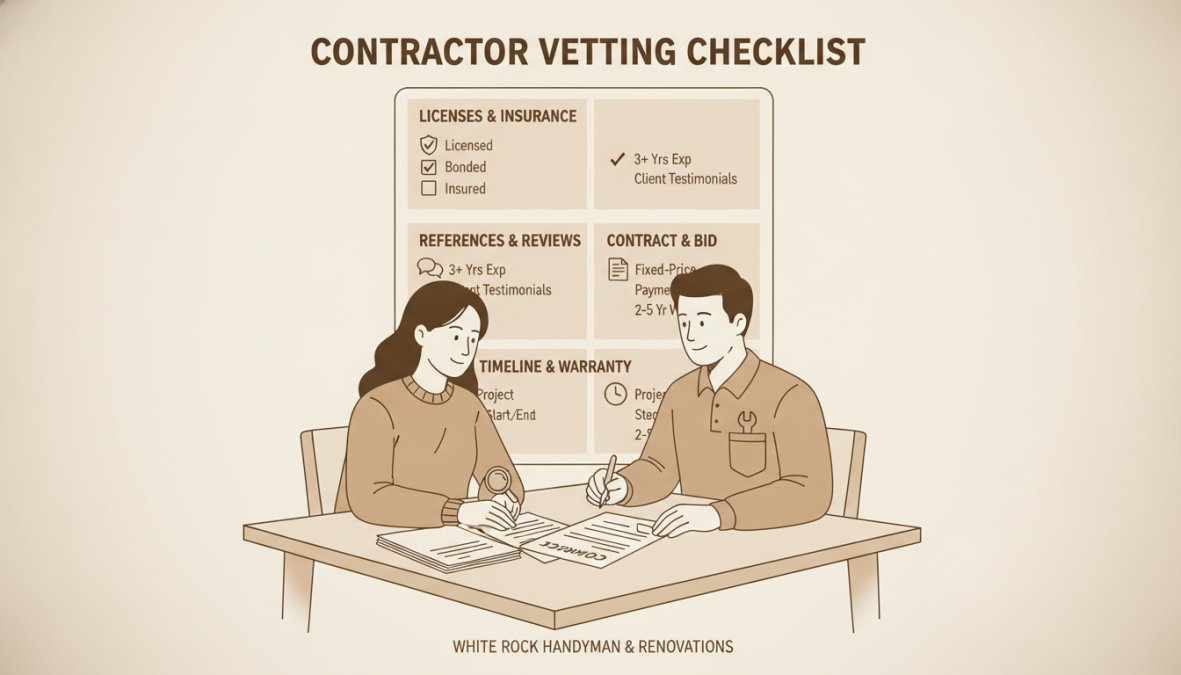
How to Vet a General Contractor: A Contractor Vetting Checklist
Choosing the right contractor is the single most important decision in any renovation. A poor choice costs time, money, and stress. A strong choice delivers quality work on schedule within budget.
Verify Licensing, Insurance, and WorkSafeBC Clearance
In British Columbia, residential contractors must hold a valid business licence from their municipality and carry Commercial General Liability (CGL) insurance with minimum $2 million coverage. Many municipalities also require contractors to be registered with WorkSafeBC and hold a current clearance letter.
Ask each contractor for:
- A copy of their municipal business licence
- Proof of current CGL insurance
- A WorkSafeBC clearance letter
- Proof of bonding if your project exceeds $25,000
Verify these documents independently by calling WorkSafeBC or contacting your municipality’s business licensing office. This takes 15 minutes and eliminates the risk of hiring someone operating illegally.
Check References and Past Projects
Request a minimum of three recent references from projects similar in scope to yours. Ask whether the contractor finished on time, handled cost overruns transparently, and remained responsive to concerns.
Ask the contractor if you can visit a completed project in person. Seeing finished work and talking directly to homeowners provides insight no portfolio can match. Pay attention to detail: are trim lines clean, are finishes consistent, are fixtures properly installed?
Review Warranty and Workmanship Guarantees
Ask what warranty the contractor offers on labour and materials. A typical workmanship warranty covers defects in installation for 1 to 2 years. Get warranty terms in writing and understand what’s covered and excluded.
|
Vetting Checkpoint |
What to Verify |
Why It Matters |
|---|---|---|
|
Licensing |
Active municipal business licence |
Confirms legal operating status |
|
Insurance |
Current CGL coverage, $2M+ limits |
Protects you if injury or damage occurs |
|
WorkSafeBC |
Current clearance letter |
Confirms worker safety standards |
|
References |
Three recent similar projects |
Validates quality and reliability |
|
Past Projects |
Site visit to completed work |
Direct assessment of craftsmanship |
|
Warranty |
Written guarantee on labour and materials |
Defines your recourse if issues emerge |
Questions to Ask Renovation Contractors Before Hiring
Ask how the contractor handles change orders. Renovations often uncover surprises, hidden structural issues, outdated wiring, unexpected material costs. A contractor who explains the situation clearly, provides options, and gets your written approval before proceeding minimises conflict.
Clarify the payment schedule. Most contractors request a deposit (10-20%) to secure the start date, progress payments as work advances, and a final payment upon completion. Avoid contractors demanding large upfront payments.
Ask about the project timeline and what factors might extend it. Weather, permit delays, material shortages, and unforeseen structural issues all affect duration. A contractor who provides a realistic timeline and explains potential delays upfront manages expectations better.
Discuss how the contractor coordinates with subcontractors and ensures quality from each trade.
Average Home Renovation Timeline and Project Management
Understanding typical timelines helps you plan your life around the project and assess whether a contractor’s schedule is realistic.
A bathroom renovation typically takes 6 to 10 weeks. Kitchen remodels usually span 8 to 12 weeks. Whole-home renovations can stretch 4 to 6 months or longer. Home additions with structural work often take 5 to 7 months.
These timelines assume no major surprises. Hidden structural damage, permit delays, or material backorders extend schedules. A contractor who pads the timeline slightly and finishes early builds trust.
Project management involves coordinating multiple trades so each arrives when the previous work is ready. Ask your contractor how often you’ll receive updates. Weekly check-ins via email or phone call are standard. Some contractors use project management apps where you can see progress photos and notes in real time.
Project Cost Estimation and Renovation Financing Options
Budget uncertainty is one of the biggest sources of stress in renovations. Understanding cost drivers and financing options helps you plan confidently.
Understanding Renovation Costs and Budgeting
Renovation costs break down into material (40-50%), labour (30-40%), permits and inspections (5-10%), and contingency (10-15%).
Costs vary significantly by region and material quality. Get detailed quotes from at least three contractors. A thorough quote breaks down costs by category, framing, electrical, plumbing, finishing, rather than providing a single lump sum.
Set aside a contingency reserve of 10-15% for unexpected costs. Renovations almost always reveal surprises: hidden water damage, outdated wiring, or structural issues requiring reinforcement.
Financing Solutions for BC Homeowners
Home equity lines of credit (HELOCs) are popular because interest rates are typically lower than credit cards. Home equity loans offer fixed rates and predictable payments. Some banks offer renovation-specific loans with simplified approval.
Before committing to financing, compare options across multiple lenders. A 1-2% difference in interest rate significantly impacts total cost over time.
Research whether your municipality offers incentive programs for energy-efficient renovations. Some BC communities provide rebates or tax credits for upgrades like heat pump installation, insulation improvements, or window replacement.
Permitting, Building Codes, and Zoning Compliance in BC
In British Columbia, most renovations require a permit if they involve structural changes, electrical work, plumbing, or HVAC modifications. Kitchen and bathroom remodels typically require permits. Additions always require permits because they affect your home’s footprint.
Your municipality has specific building code requirements and zoning rules. Setbacks define how far your home must sit from property lines. Height restrictions limit how tall a second storey can be. A contractor experienced in your specific municipality understands these local rules.
Building inspectors verify that work meets code at key stages: foundation, framing, electrical rough-in, plumbing rough-in, and final completion. Schedule inspections promptly to avoid delays.
According to BC Building Code requirements for residential construction, all work must comply with current standards for safety, accessibility, and energy efficiency.
Sustainability and Energy Efficiency in Home Renovations
Modern renovations increasingly incorporate energy-efficient upgrades that reduce utility bills and environmental impact.
Heat pump technology now provides efficient heating and cooling in BC’s climate. Upgrading from an older furnace to a heat pump reduces energy consumption by 30-50%. Many BC homeowners qualify for rebates on heat pump installation through provincial or utility programs.
Insulation improvements in walls, attics, and basements reduce heating and cooling needs. Upgrading to high-performance windows minimises heat loss. Tankless water heaters or heat pump water heaters use less energy than traditional tank systems.
When planning renovations, ask your contractor which efficiency upgrades fit your budget. Some upgrades qualify for tax credits or utility rebates, effectively reducing their net cost.
Natural Resources Canada’s energy efficiency rebate programs lists current incentives for homeowners upgrading insulation, windows, heat pumps, and water heaters.
Research from Canada Mortgage and Housing Corporation on renovation ROI shows that energy-efficient upgrades recover 50-80% of their cost through utility savings and increased home value. Kitchen and bathroom renovations recover 60-70% of costs, while additions typically recover 80-90%.
Choosing the right full service home renovation contractor determines whether your project becomes a source of pride or stress. The vetting process, checking licensing, reviewing references, confirming insurance and WorkSafeBC clearance, and asking detailed questions, takes time but eliminates risk. White Rock Handyman & Renovations brings 37 years of experience, full licensing and bonding, and a commitment to transparent pricing with no hidden fees. Our team in Surrey, South Surrey, White Rock, Langley, Cloverdale, and Delta has delivered 110+ five-star rated projects completed to code with satisfaction guaranteed. Get a free estimate today and start your renovation with confidence.
Frequently Asked Questions
What does a full service home renovation contractor do?
A full service home renovation contractor manages your entire project from start to finish—design, permits, construction, and final inspection. They coordinate subcontractors, source materials, ensure work meets building codes, and handle inspections. This turnkey approach gives homeowners a single point of accountability rather than juggling multiple tradespeople.
How do I find reputable home renovation contractors in BC?
Look for contractors with current municipal business licensing (Surrey, White Rock, Langley, etc.), WorkSafeBC clearance letters, and Commercial General Liability (CGL) insurance. Check online reviews, ask for references from past projects, and request detailed written quotes. Interview at least three contractors before deciding.
What questions should I ask renovation contractors before hiring?
Ask about licensing and insurance status, project timeline and milestones, how they handle permit applications, warranty coverage, payment schedule, and what happens if costs exceed the estimate. Request a detailed scope of work in writing and clarify how change orders are managed. These conversations reveal professionalism and transparency.
How long does an average home renovation project take?
Timeline varies by scope. A kitchen remodel typically takes 6–12 weeks; a bathroom renovation, 4–8 weeks. Whole-home renovations can take 3–6 months or longer. Factors include permit delays, material availability, structural surprises, and project complexity. Your contractor should provide a realistic schedule upfront.
What financing options are available for home renovations in BC?
BC homeowners can explore home equity lines of credit (HELOCs), personal loans, renovation mortgages, and government grants for energy-efficiency upgrades. Some contractors offer financing partnerships. Compare interest rates and terms carefully. Discuss options with your lender before committing to a renovation budget.