
Table of Contents
- How to Plan Kitchen Remodel Budget: Key Phases
- Setting a Realistic Budget for Your Kitchen Renovation
- Kitchen Renovation Cost Breakdown: Where Your Money Goes
- Planning for Unexpected Expenses and Contingency Funds
- Kitchen Renovation Permits Vancouver and Lower Mainland: Legal Requirements
- Kitchen Renovation Financing Canada: Options and How to Choose
- Hiring a Contractor BC: What to Budget for Labour and Expertise
- Material Selection: Budget-Friendly Choices Without Compromising Quality
Last Updated: July 25, 2026
How to Plan Kitchen Remodel Budget: Key Phases
Planning a kitchen renovation requires breaking your project into distinct phases. At White Rock Handyman & Renovations, we’ve guided hundreds of Lower Mainland homeowners through this process, and the difference between projects that stay on track and those that spiral comes down to structured planning from the start. Think of kitchen renovation planning as a series of sequential decisions, each one informing the next.
The first step is understanding your scope. Are you refreshing dated finishes, or restructuring the entire workflow? A cosmetic refresh (new cabinetry, countertops, backsplash, fixtures) runs a different budget than one involving plumbing relocation, electrical upgrades, or structural changes.
Phase 1: Assess Your Current Kitchen and Goals
Document what stays and what goes. Photograph the current layout, measure square footage, and note existing conditions: are cabinets solid wood or particleboard? Is flooring original or recently replaced? Are appliances functioning or failing?
Next, list what frustrates you daily. Does the layout force you to work in cramped quarters? Are there storage gaps? Is lighting inadequate? These pain points define your priorities and prevent budgeting for work you don’t actually need.
Phase 2: Define Your Must-Haves vs. Wish List
Separate non-negotiables from nice-to-haves. Must-haves are typically functional: replacing worn countertops, upgrading appliances that no longer work reliably, improving storage, or fixing layout issues. Wish list items are usually aesthetic: a kitchen island, premium hardware, or custom backsplash tile.
This distinction is critical because it’s where budget discipline lives. When costs rise during renovation, you need to know what you’ll protect and what you’ll cut. A homeowner who hasn’t made this distinction beforehand tends to make panic decisions mid-project.
Setting a Realistic Budget for Your Kitchen Renovation
Budget reality depends on scope. A kitchen renovation in British Columbia ranges dramatically based on what you’re actually changing. Define the work first, then determine the budget required.
Start by researching typical kitchen renovation costs in your region. Lower Mainland kitchen projects vary by municipality, Surrey, White Rock, Langley, and Delta each have different permit requirements, labour availability, and material sourcing costs that affect final pricing. Get multiple contractor quotes early, before you’re emotionally invested in a specific design.
Your budget should account for three layers: the essential work (structural, plumbing, electrical), the visible work (cabinetry, countertops, flooring), and the contingency fund (typically 15-20% of total budget). Many homeowners budget only the visible layer and get blindsided when hidden issues emerge: rotted subfloors, outdated wiring that needs upgrading, or plumbing that doesn’t meet current code.
Kitchen Renovation Cost Breakdown: Where Your Money Goes
Understanding where renovation dollars go prevents sticker shock and helps you make informed trade-offs. A typical kitchen renovation budget divides into six major categories.
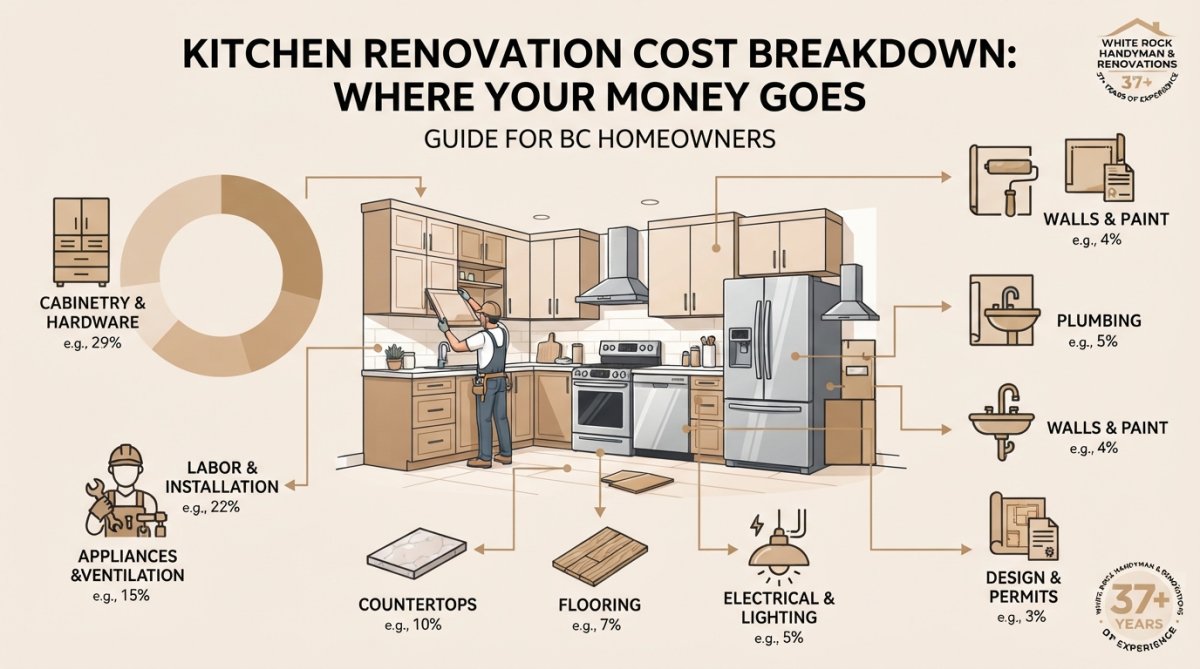
Cabinetry and Storage
Cabinetry typically represents 30-40% of a kitchen renovation budget. The cost range is wide: stock cabinetry costs less than semi-custom, which costs less than fully custom. Refacing existing cabinets costs less than replacing them entirely.
Quality cabinetry lasts 20+ years and handles daily wear. Budget cabinetry may show damage within 5-7 years. Semi-custom cabinetry with solid construction and reasonable design flexibility works for most Lower Mainland homeowners. Storage efficiency matters more than cabinet count, a well-designed layout with pull-out shelves and corner solutions provides more usable space than more cabinet doors that hide wasted interior space.
Countertops and Backsplash
Countertops and backsplash typically account for 15-25% of renovation budget. Countertop material choice drives cost more than size. Laminate costs significantly less than solid surface materials, which cost less than natural stone (granite, marble, quartz). Backsplash material varies similarly.
Durability and maintenance differ across materials. Granite requires sealing annually. Quartz requires minimal maintenance. Laminate scratches and stains more easily but costs a fraction of alternatives. Labour for countertop and backsplash installation is straightforward if the layout is simple; complex layouts with multiple angles or islands increase labour time and cost.
Appliances and Fixtures
Appliances and fixtures typically represent 15-20% of budget. This includes range/cooktop, oven, refrigerator, dishwasher, microwave, faucet, and sink. Budget appliances are functional but may have shorter lifespans. Mid-range appliances balance cost and reliability. For most homeowners, mid-range makes sense, the performance jump from budget to mid-range is significant, but the jump from mid-range to premium is incremental.
Faucet and sink quality matter for daily usability. A poor-quality faucet that leaks within 3 years creates frustration and additional cost. A mid-range faucet typically lasts 10+ years.
Labour and Installation
Labour typically represents 25-35% of total renovation budget. This includes demolition, installation of cabinetry, countertops, flooring, appliances, and fixtures, plus any required carpentry, plumbing, or electrical work.
Labour cost depends on project complexity and local market rates. Straightforward projects with minimal structural changes cost less than projects requiring custom carpentry, plumbing relocation, or electrical upgrades. A licensed, insured, bonded contractor like White Rock Handyman & Renovations costs more than an unlicensed alternative, but you’re protected if something goes wrong. Unlicensed work may not meet code and creates liability if future issues arise.
Flooring and Lighting
Flooring typically represents 8-12% of budget. Material choices range from budget vinyl to premium hardwood or natural stone. Durability matters in kitchens because spills and foot traffic are constant. Vinyl is affordable and water-resistant. Tile is durable and easy to clean. Engineered hardwood balances appearance with moisture resistance.
Lighting typically represents 5-8% of budget. Many kitchens are under-lit, creating shadows over work surfaces. Layered lighting (overhead, task lighting under cabinets, accent lighting) costs more than single-fixture lighting but dramatically improves functionality and ambiance.
|
Cost Category |
Typical Budget Percentage |
Key Cost Drivers |
|---|---|---|
|
Cabinetry |
30-40% |
Material quality, custom vs. semi-custom, hardware |
|
Countertops & Backsplash |
15-25% |
Material type, edge detail, installation complexity |
|
Appliances & Fixtures |
15-20% |
Brand, features, quality level |
|
Labour & Installation |
25-35% |
Complexity, plumbing/electrical work, contractor experience |
|
Flooring |
8-12% |
Material durability, installation difficulty |
|
Lighting |
5-8% |
Fixture quality, electrical upgrades needed |
Planning for Unexpected Expenses and Contingency Funds
Renovation projects almost always reveal hidden issues. A contingency fund of 15-20% of your total budget is essential, not optional. This fund covers problems discovered during demolition: rotted subfloors, outdated plumbing that needs replacement, electrical issues that don’t meet current code, or structural repairs needed before new work can proceed.
Many homeowners treat contingency funds as optional, then face difficult choices when unexpected costs emerge. A contingency fund prevents these surprises from derailing your project. Document any issues discovered during demolition with photos and get written estimates for unexpected work before authorizing it.
Kitchen Renovation Permits Vancouver and Lower Mainland: Legal Requirements
Kitchen renovations in British Columbia typically require permits from your municipality. Permit requirements vary by scope of work, but understanding what requires a permit prevents costly mistakes and ensures work meets code.
When Permits Are Required
Permits are required when work involves structural changes, plumbing relocation, electrical upgrades, or changes to kitchen layout that affect building systems. Replacing cabinetry and countertops without moving plumbing or electrical typically doesn’t require a permit. Adding or relocating a kitchen island, moving sink location, upgrading electrical service, or relocating plumbing always requires permits.
Your municipality, whether Surrey, White Rock, Langley, Cloverdale, or Delta, has specific permit requirements. A licensed contractor knows these requirements and handles permit applications as part of the project.
Contractor Licensing and Insurance
In British Columbia, contractors performing renovation work should hold appropriate licensing. For electrical or plumbing work, the contractor must be licensed in those trades. Before hiring, ask for proof of Commercial General Liability (CGL) insurance, WorkSafeBC clearance letters (confirming the contractor maintains required coverage), and municipal business licensing for their service area.
White Rock Handyman & Renovations maintains full licensing, insurance, and bonding across Surrey, South Surrey, White Rock, Langley, Cloverdale, and Delta. This protects you if injury or property damage occurs during the project. Unlicensed or uninsured contractors may offer lower quotes, but you assume liability if something goes wrong.
Kitchen Renovation Financing Canada: Options and How to Choose
Kitchen renovation budgets often exceed what homeowners have available in savings. Several financing options exist, each with different terms and implications.
Home Equity Lines of Credit (HELOC)
A HELOC lets you borrow against your home’s equity at variable interest rates, typically lower than personal loans or credit cards. You draw funds as needed and pay interest only on what you borrow. This works well if you have significant home equity and can manage variable interest rates. The downside is that your home is collateral, and rates can increase if interest rates rise.
Personal Loans and Credit Options
Personal loans from banks or credit unions offer fixed interest rates and predictable payments. Rates are higher than HELOCs but lower than credit cards. Credit cards offer flexibility but charge high interest rates, making them suitable only for small portions of renovation cost that you can repay quickly.
Savings and Cash Payment
Paying cash avoids interest and debt, but depletes emergency savings. A balanced approach is using savings for a portion and financing the remainder, reducing debt while preserving emergency reserves.
Hiring a Contractor BC: What to Budget for Labour and Expertise
Labour cost is a major portion of kitchen renovation budget, but it’s where quality variation is highest. An experienced, licensed contractor delivers work that lasts decades. An inexperienced or unlicensed contractor may create problems that cost more to fix than the original renovation.
Evaluating Contractor Quotes
Get written quotes from at least three contractors. Quotes should detail scope of work, materials, labour, timeline, and total cost. Compare not just price, but what’s included. Check references from past projects and ask to see completed kitchens. Verify licensing and insurance before hiring by requesting proof of CGL insurance, WorkSafeBC clearance letters, and municipal business licensing.
White Rock Handyman & Renovations provides detailed quotes with no call-out fees, allowing you to compare actual scope against price before committing.
Avoiding Hidden Fees and Budget Overruns
Hidden fees emerge when scope isn’t clearly defined. A detailed quote that itemizes labour, materials, and specific tasks prevents disagreements about what’s covered. Establish a change-order process before work starts. If unexpected work is needed or you request changes, get a written estimate for the additional cost before authorizing it.
Timeline matters for budget. Projects that drag on accumulate additional labour cost. A contractor who commits to a specific timeline and has systems to stay on schedule is preferable to one who’s vague about duration.
Material Selection: Budget-Friendly Choices Without Compromising Quality
The strategy is choosing mid-range for items you interact with daily (countertops, faucet, appliances) and budget-friendly for items that are less critical (backsplash tile, cabinet hardware, lighting fixtures). This balances cost with durability and satisfaction.
Cabinetry is where this matters most. Quality cabinet boxes with solid construction and good hardware last 20+ years. Mid-range semi-custom cabinetry balances cost and longevity for most kitchens. Countertop material choice involves similar trade-offs. Quartz costs more than laminate but requires minimal maintenance and lasts longer. For a kitchen you’ll use intensively for decades, quartz is worth the premium.
Appliances follow the same pattern. Mid-range appliances have better reliability, longer warranties, and more useful features than budget options. Flooring durability matters in kitchens because spills and traffic are constant. Tile or engineered hardwood lasts longer and handles moisture better than vinyl. Lighting is where budget choices make sense, basic fixtures are affordable and functional, and this is one category where spending less doesn’t compromise quality.
The overall principle: spend more on items you use constantly and that affect kitchen function (cabinetry, countertops, appliances, faucet). Spend less on decorative elements (backsplash tile, cabinet hardware, light fixtures) that are easier to update later if you want to change the look.
Kitchen renovation planning is a deliberate process that prevents costly surprises and ensures you get the kitchen you actually want within a realistic budget. The difference between a successful renovation and a frustrating one usually comes down to clear planning, detailed budgeting, and hiring the right contractor.
White Rock Handyman & Renovations has guided hundreds of Lower Mainland homeowners through kitchen renovations, from minor updates to complete overhauls. Our team is fully licensed, insured, and bonded, maintains WorkSafeBC clearance letters, and holds municipal business licensing across Surrey, South Surrey, White Rock, Langley, Cloverdale, and Delta. We provide detailed written quotes with no call-out fees and guarantee work completed to code with no hidden surprises. Get a free estimate and discover how transparent planning creates kitchens that work for decades.
Frequently Asked Questions
What is a realistic budget for a kitchen renovation in British Columbia?
A realistic kitchen remodel budget in BC depends on scope and materials. A basic refresh focusing on cabinetry, countertops, and fixtures differs significantly from a full renovation with structural changes and new appliances. We recommend starting with a detailed assessment of your goals—must-haves versus wish list items—and consulting with a licensed contractor for a transparent quote. This ensures your budget aligns with regional labour costs and material availability across Surrey, White Rock, Langley, and Delta.
Do I need permits for a kitchen renovation in Surrey or White Rock?
Most kitchen renovations in Surrey, White Rock, and the Lower Mainland require municipal permits if they involve structural changes, plumbing, electrical work, or gas lines. Permit requirements vary by municipality, so verification with your local authority is essential. A licensed contractor with municipal business licensing can handle permit applications and arrange inspections. This protects you legally and ensures work meets code requirements—a critical step many homeowners overlook.
How can I finance a kitchen renovation in British Columbia?
BC homeowners have several financing options: HELOCs (home equity lines of credit) offer flexible access to funds; personal loans provide fixed terms; savings allow interest-free renovation; and some contractors offer payment plans. Each option has different interest rates, terms, and approval timelines. Consider your timeline, total budget, and comfort with debt before choosing. Consulting your bank or financial advisor helps match the financing method to your specific situation.
What should I look for when hiring a contractor for a kitchen remodel in BC?
When hiring a contractor, verify WorkSafeBC clearance letters, Commercial General Liability (CGL) insurance, and current municipal business licensing. Request detailed, itemized quotes with no hidden fees—transparent pricing is a hallmark of trustworthy contractors. Ask for references, check online reviews, and confirm they complete work to code requirements. A licensed, insured, and bonded contractor protects you from liability and ensures quality craftsmanship throughout your renovation.