
Last Updated: October 27, 2026
Quick Summary
The best bathroom ventilation for homeowners is a correctly sized exhaust fan ducted outdoors, typically around one CFM per square foot of floor area, upgraded with a humidity sensor or timer. Size up for high ceilings, enclosed showers, and long duct runs, and never vent into the attic.
- A 100-square-foot bathroom with a nine-foot ceiling needs about 120 CFM, not the flat rule.
- Duct runs longer than 10 feet or with more than two elbows call for sizing up one step.
- Humidity-sensing fans switch on automatically and shut off once the air dries out.
- An HRV or ERV complements bathroom ventilation but never replaces a dedicated exhaust fan.
- Ventilation is easiest and cheapest to plan before walls and ceilings are closed.
Table of Contents
- Why Bathroom Ventilation Matters More on the Coast
- Bathroom Fan Sizing: Matching CFM to Your Square Footage
- The Humidity-Sensing Bathroom Fan: Set-and-Forget Moisture Control
- Bathroom Ventilation for Small Bathrooms: Compact Solutions That Perform
- Bathroom Fan Ventilation Duct: Routing It Right and Terminating Outdoors
- Comparing Ventilation Solutions: Fans, ERVs, and Window Options
- Planning Ventilation Into Your Bathroom Renovation
- Frequently Asked Questions
Why Bathroom Ventilation Matters More on the Coast
Bathroom ventilation is the controlled removal of moist, stale air and its replacement with drier air.
At White Rock Handyman & Renovations, we’ve spent 37+ years renovating bathrooms across Surrey, South Surrey, White Rock, Langley, Delta, Cloverdale, and Tsawwassen.
The [Home Ventilating Institute’s bathroom ventilation guidance | hvi.org] suggests roughly eight air changes per hour, about one CFM per square foot of floor area for most bathrooms. That’s a starting point, not a code requirement: duct resistance reduces real airflow, so a fan may deliver less than its box rating on a long or winding run.
What that means for you: foggy mirrors, condensation on window frames, and eventually mold in the grout lines and ceiling corners. For a closer look at the risks, see how to prevent mold in bathrooms with poor ventilation.
Bathroom Fan Sizing: Matching CFM to Your Square Footage
Bathroom fan sizing starts with floor area but does not end there. The number you need is the fan’s CFM rating, cubic feet of air moved per minute, and the right CFM depends on room volume, fixtures, and the duct run’s length and complexity.
Start with floor area
Measure length times width to get square footage, then apply the long-standing one-CFM-per-square-foot guideline. It is a starting point, not a code citation, and it assumes an eight-foot ceiling and a straightforward duct run.
| Bathroom Floor Area | Baseline Fan Capacity | Typical Use Case |
|---|---|---|
| Under 50 sq ft | Around 50 CFM | Powder rooms, small ensuites |
| 50 to 100 sq ft | Around 80 to 110 CFM | Standard family bathrooms |
| 100 to 120 sq ft | 110 to 130 CFM | Larger hall bathrooms, primary ensuites |
| Over 120 sq ft | 130 CFM and up, sized by volume | Master ensuites, bathrooms with enclosed showers |
Adjust for ceiling height and room volume
The one-CFM-per-square-foot rule assumes an eight-foot ceiling. If yours is nine or ten feet, the room holds more air. Multiply floor area by ceiling height for cubic feet, then aim for roughly eight air changes per hour: a 100-square-foot bathroom with a nine-foot ceiling holds 900 cubic feet, so eight air changes means about 120 CFM, more than the flat rule suggests.
Add capacity for enclosed showers and tubs
A shower enclosed with frameless glass or a tiled half-wall traps steam in a small volume, so most practitioners add capacity for an enclosed shower or large soaker tub. If your renovation includes a walk-in shower with glass, size up rather than sizing to the flat rule.
Account for duct resistance
The CFM on the box is a lab rating measured at minimal static pressure. A fan pushing through a long duct, several elbows, a roof cap, or a backdraft damper moves less air in the real world; a fan rated at 110 CFM at zero inches of water column may deliver considerably less at 0.25 inches.
A simple sanity check: if your duct run is longer than about 10 feet, has more than two elbows, or terminates through a roof cap rather than a wall cap, treat the fan’s rated CFM as a ceiling, not a guarantee, and choose the next size up.
What provincial requirements add
Ventilation is not purely a comfort choice. Provincial building requirements address mechanical ventilation of bathrooms, and a renovation that alters or adds a bathroom typically has to meet them. Exact figures depend on the code edition in force and how the local authority having jurisdiction interprets it, so confirm the requirement before you buy a fan.
Worked examples
- A 5 ft by 8 ft powder room (40 sq ft), eight-foot ceiling, short straight duct: around 50 CFM is adequate.
- A 5 ft by 9 ft hall bathroom (45 sq ft) with a tub and shower combination, eight-foot ceiling, 12-foot duct with one elbow: around 80 CFM gives headroom for the duct run.
- A 10 ft by 12 ft primary ensuite (120 sq ft), nine-foot ceiling, enclosed glass shower, 15-foot duct with two elbows and a roof cap: the volume math points to roughly 145 CFM, and duct resistance argues for sizing up further. A 150 CFM fan is a reasonable starting point; confirm the final selection against the manufacturer’s performance curve at your estimated static pressure.
Sizing determines whether the fan actually clears the room. Get it right on paper, then verify it in the duct.
The Humidity-Sensing Bathroom Fan: Set-and-Forget Moisture Control
A humidity-sensing bathroom fan, also called a humidistat fan, switches itself on when moisture rises past a set point and shuts off once the air dries out. That matters because the most common ventilation mistake isn’t buying the wrong fan, it’s not running the right one long enough.
Pair that with a quiet, continuously running unit and the room stays dry without anyone thinking about it.
Bathroom Ventilation for Small Bathrooms: Compact Solutions That Perform
Small bathrooms are the hardest rooms to ventilate well: less air volume to clear, less wall and ceiling space for a fan, and often a short, awkward duct run. For layout inspiration, see these bathroom renovation ideas for small spaces.
Three approaches work:
- A compact high-CFM fan mounted in the ceiling, sized to the room’s actual square footage rather than guessed
- An inline fan placed in the attic or joist space, with a grille in the ceiling, so the mechanical unit sits away from the room
- A through-wall fan for rooms where a ceiling duct run simply isn’t possible
Noise matters more in a tiny room, so check the sones rating, not just the CFM. A fan that rattles or roars gets switched off, and a fan that’s off does nothing.
Bathroom Fan Ventilation Duct: Routing It Right and Terminating Outdoors
The duct is where good fans go to die. A bathroom fan ventilation duct must run as short and straight as possible and terminate outdoors, never into the attic.
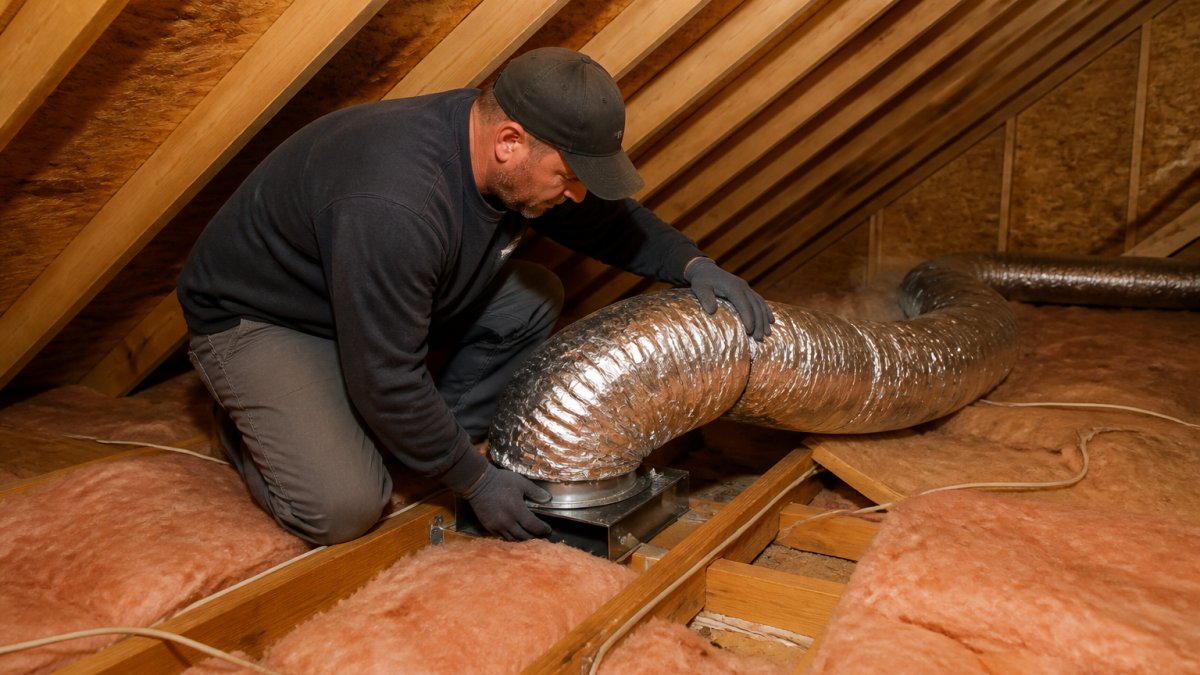
Watch out: a duct that slopes back toward the fan lets condensation drip into the unit and stain the ceiling below. Slope it slightly toward the exterior termination.
Comparing Ventilation Solutions: Fans, ERVs, and Window Options
A bathroom can be ventilated by several approaches, and the right one depends on the room, the home, and how the space is used. Here is a structured comparison of the options a homeowner is likely to weigh.
Standard exhaust fan
The default solution for most bathrooms. A ceiling- or wall-mounted fan pulls moist air out through a duct to the exterior, simple, widely available, and effective when sized and ducted correctly. The trade-off: it only works when it runs, so it depends on the occupant remembering to switch it on and leave it on long enough.
Humidity-sensing and motion-sensing fans
A humidity-sensing fan switches itself on when moisture rises past a set point and off once the air dries out; a motion-sensing fan runs when someone enters and continues on a timer afterward. Both remove the human error that undermines standard fans. The trade-off is higher purchase cost and, for humidity sensors, a set point that needs adjusting to the home’s conditions rather than left at the factory default.
Timer-controlled fans
A wall timer or a fan with a built-in delay lets the occupant press a button and walk away while the fan runs for a set period, commonly 20 to 60 minutes. It’s a low-cost upgrade that fixes the most common mistake: switching the fan off the moment you leave the shower.
Continuously running low-speed fans
Some fans run continuously at low speed and boost to high speed on demand, keeping baseline humidity in check and often paired with a motion or humidity sensor for the boost. The trade-off: the fan must be rated for continuous duty and quiet enough that occupants do not notice it; a noisy fan running 24 hours a day is not a realistic solution.
Inline and remote-mounted fans
An inline fan sits in the attic or joist space with a grille in the ceiling, moving mechanical noise away from the room. It’s useful in small bathrooms where a ceiling-mounted unit would be intrusive, and it can serve two bathrooms from one fan with the right duct design. The trade-off is a more complex installation and a duct layout that has to be planned carefully.
Heat-recovery and energy-recovery ventilators (HRVs and ERVs)
An HRV or ERV is a whole-home system that brings in fresh air while recovering heat from the outgoing air. It improves indoor air quality across the house and is increasingly common in tightly built homes. It does not, however, replace a bathroom exhaust fan: the bathroom still needs a dedicated fan to remove concentrated moisture at the source.
Opening a window
The oldest solution and the least reliable. It works in mild weather and fails in winter, when nobody wants to open a window during or after a shower. It also does not control where the moist air goes or how much leaves. Relying on a window as the primary ventilation strategy is a common reason bathrooms develop persistent moisture problems.
Side-by-side comparison
| Solution | Best for | Main trade-off |
|---|---|---|
| Standard exhaust fan | Most bathrooms, budget-conscious renovations | Depends on occupant operation |
| Humidity-sensing fan | Bathrooms where occupants forget to run the fan | Higher cost, set point needs tuning |
| Motion-sensing fan | High-traffic bathrooms, family homes | Runs when occupied, not only when humid |
| Timer-controlled fan | Low-cost upgrade to an existing fan | Still relies on a button press |
| Continuously running low-speed fan | Homes wanting baseline humidity control | Must be rated for continuous duty and quiet |
| Inline / remote fan | Small bathrooms, multi-bathroom setups | More complex duct planning |
| HRV / ERV | Tightly built homes needing whole-home fresh air | Does not replace the bathroom fan |
| Window | Mild-weather supplemental ventilation only | Unreliable in winter, no control |
How to choose
For most renovations, a standard exhaust fan sized correctly and ducted properly is the right answer, optionally upgraded with a humidity sensor or timer. If the home is tightly built and has or is considering an HRV or ERV, plan the bathroom fan as a separate system.
The decision is easiest to make before walls are closed.
Planning Ventilation Into Your Bathroom Renovation
The cheapest time to get ventilation right is during a renovation. You can also request a free project estimate with no obligation. If you’re ready to move forward, explore our bathroom renovations and book a free estimate.
Our standard and small bathroom renovations are typically completed in just one week (5 to 7 business days), which is possible because we run a one-project-at-a-time model. Our crew stays on your project until it’s finished.
We hold full WorkSafeBC clearance letters, $5 million Commercial General Liability (CGL) insurance, and municipal business licensing across Surrey, South Surrey, White Rock, Langley, Delta, Cloverdale, and Tsawwassen. A 50% deposit of the total invoice books and secures the project.
Frequently Asked Questions
What is the best way to ventilate a bathroom?
The best approach is a correctly sized exhaust fan ducted straight to the outdoors through the shortest, straightest run possible.
Should a bathroom exhaust fan vent outside?
Yes. Venting into an attic or crawlspace pushes warm, moist air into a cold space where it condenses on framing and insulation. Over time that supports mold growth and can rot structural wood. Route the bathroom fan ventilation duct to a wall or roof cap with a backdraft damper, keep the run short, and insulate ducts that pass through unconditioned space.
Are humidity-sensing bathroom fans worth it?
For most households, yes. A humidity-sensing bathroom fan switches on or stays on based on moisture levels rather than a timer, so it keeps running until the air is actually dry. Panasonic’s 2026 fan guide describes its WhisperSense DC model with built-in motion sensing for automatic operation. That removes the guesswork and helps prevent mold and foggy mirrors in bathrooms that get heavy use.
How long should a bathroom exhaust fan run after a shower?
Run it for at least 20 to 30 minutes after you finish showering, or until the mirror clears and the room feels dry. A humidistat or humidity-sensing fan handles this automatically. In a well-sealed home, running the fan longer costs little because modern units use far less power than older models, and consistent runtime is what actually removes excess moisture before it condenses.
If your bathroom fogs up every morning and the fan never quite clears it, the fix is usually a properly sized fan on a clean, insulated duct run. White Rock Handyman & Renovations builds ventilation into every bathroom renovation, with humidity-sensing fans, correctly routed exterior ductwork, and code-compliant electrical work. Get started with White Rock Handyman & Renovations and get a bathroom that stays dry all winter.
