
Table of Contents
- Why Bathroom Lighting Matters More Than You Think
- Bathroom Lighting Layers: The Foundation of Proper Design
- Moisture-Rated Bathroom Light Fixtures: A Safety Essential
- Bathroom Lighting Design Best Practices
- Bathroom Renovation Electrical Code Requirements
- Smart Home Integration and Modern Controls
- Professional Installation vs. DIY Approach
- Upgrading Bathroom Lighting Adds Real Value
- Frequently Asked Questions
Last Updated: September 29, 2026
Why Bathroom Lighting Matters More Than You Think
Understanding why you should upgrade your bathroom lighting starts with recognizing how poor lighting affects safety, appearance, and daily comfort. Many homeowners assume a single fixture above the mirror is sufficient, but proper lighting requires a layered approach.
Why you should upgrade your bathroom lighting goes beyond aesthetics. The right system protects your skin during grooming, prevents accidents in wet zones, and transforms bathroom function. At White Rock Handyman & Renovations, we’ve completed hundreds of bathroom renovations across Surrey, Langley, and South Surrey. The most common regret homeowners express: “I wish we’d invested in better lighting from the start.”
Proper bathroom lighting combines three layers: ambient light for visibility, task lighting for grooming, and accent lighting for mood.
Bathroom Lighting Layers: The Foundation of Proper Design
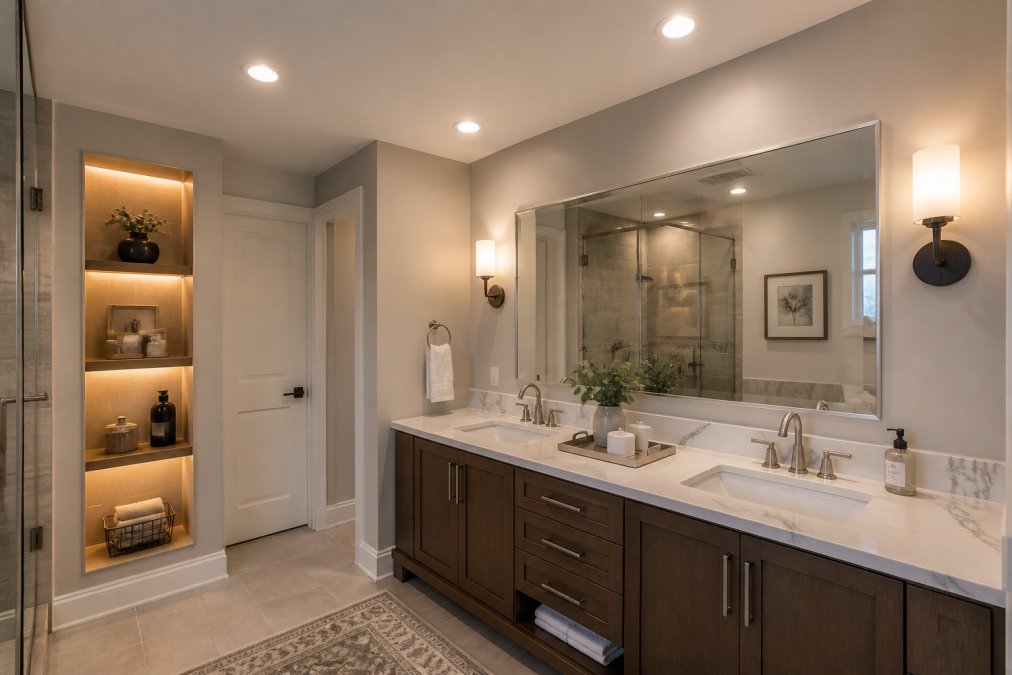
Layered lighting is the foundation of good bathroom design. Most bathrooms rely on a single overhead fixture, which creates shadows where you need light most. Ambient lighting handles baseline visibility, task lighting handles grooming work, and accent lighting handles mood.
Ambient Lighting for Overall Visibility
Ambient lighting provides baseline visibility for safe movement. Recessed ceiling lights or flush-mount fixtures work well. Most bathrooms need 50-100 lumens per square metre. Position ambient lights away from the vanity to avoid shadows on your face; instead, cover the toilet area, floor, and general space.
Task Lighting for Grooming and Makeup
Task lighting is critical for grooming. Vanity sconces on either side of the mirror eliminate shadows and provide bright, focused light. A single overhead light creates harsh shadows under eyes and chin. Aim for 150-200 lumens per square metre at the mirror. LED vanity lights are more efficient than incandescent options.
Accent Lighting for Design and Mood
Accent lighting transforms the bathroom from utilitarian to enjoyable. Common options include lights around mirror frames, behind floating vanities, in shower niches, or under vanities. Accent lighting uses fewer lumens for visual interest. Warm white LEDs create a relaxing atmosphere.
Moisture-Rated Bathroom Light Fixtures: A Safety Essential
Bathrooms are classified into electrical zones. Areas directly above tubs or showers require wet-rated fixtures; areas near sinks require damp-rated fixtures. Wet-rated fixtures have sealed components and corrosion-resistant materials for direct water contact. Damp-rated fixtures handle humidity and occasional splashing. Using the wrong rating is a code violation and safety risk.
Bathroom Lighting Design Best Practices
Good bathroom lighting design follows a few consistent principles. These principles work whether you’re renovating a small powder room or a large master ensuite.
Color Temperature and CRI for Accurate Grooming
Warm white light (2700K-3000K) is relaxing; cool white (4000K-5000K) is brighter and more clinical. Most designers recommend warm white for the overall bathroom and slightly cooler tones at the vanity. Color Rendering Index (CRI) measures how accurately light shows colours. A CRI of 90 or higher is ideal for grooming.
Vanity Lighting Placement and Shadow Reduction
Position sconces at eye level, typically 60-70 centimetres above the countertop. Space two sconces 60-80 centimetres apart for even illumination. For a single vanity light above the mirror, position it at least 30 centimetres above the mirror top. Wide mirrors (120 centimetres or more) may need three fixtures.
Dimmable Lighting and Energy Efficiency
Dimmable lighting offers flexibility for morning grooming and evening relaxation. Most modern LEDs are dimmable; pair them with a quality dimmer switch for precise control. LEDs use 75% less energy than incandescent bulbs and last 25 times longer, paying for themselves through lower electricity bills.
Bathroom Renovation Electrical Code Requirements
The Canadian Electrical Code (CEC) governs bathroom electrical installations. Key requirements include GFCI protection for all outlets within 1.5 metres of a sink, wet-rated fixtures in wet zones, damp-rated fixtures in damp zones, dedicated circuits for bathroom lighting, and exhaust fans vented to the outside.
Smart Home Integration and Modern Controls
Smart lighting is becoming standard in bathroom renovations, but bathroom-specific smart integration differs from living rooms or kitchens. Moisture, humidity, and electrical code restrictions create unique constraints that generic smart-home guides overlook.
Smart Lighting in Wet and Damp Zones
Not all smart bulbs and switches are rated for bathroom moisture. Use fixtures and bulbs specifically rated for damp or wet zones. Smart dimmer switches are more practical than smart bulbs in bathrooms, a single switch controls all bulbs on that circuit. Confirm switches are rated for damp or wet locations with specified humidity tolerance.
Circadian Rhythm and Exhaust Fan Automation
Circadian-rhythm lighting automatically adjusts colour temperature throughout the day. Morning routines benefit from cooler, brighter light (4000K-5000K) for alertness; evening routines benefit from warmer light (2700K-3000K) to avoid suppressing melatonin. Smart exhaust fan switches with humidity sensors activate automatically when humidity rises above 60-70% relative humidity, preventing moisture buildup and mould growth while reducing energy waste.
Voice Control and Accessibility
Voice-activated lighting offers accessibility benefits for aging-in-place renovations or households with mobility limitations. Hands-free control eliminates reaching light switches. Voice commands can trigger preset scenes with bright, cool morning light or softer, warmer evening light. Pair voice-controlled lighting with motion sensors for automatic activation when the bathroom is entered.
Cost and Code Compliance Considerations
Smart lighting adds upfront cost but reduces energy consumption by preventing lights left on accidentally and optimizing exhaust fan runtime. All smart devices must comply with the Canadian Electrical Code (CEC). Smart switches must be installed on dedicated circuits and protected by GFCI outlets where required.
Professional Installation vs. DIY Approach
Bathroom lighting installation looks straightforward, but Canadian electrical code and moisture safety create legal and safety boundaries that determine what homeowners can and cannot do themselves.
What Homeowners Can Do (With Caution)
In British Columbia, homeowners may perform electrical work on their primary residence if it complies with the Canadian Electrical Code (CEC) and is inspected and approved by the local authority having jurisdiction. Homeowners can typically replace existing light bulbs and fixtures of the same type and wattage, install new fixtures on existing circuits (if not overloaded and moisture-rated), and install dimmer switches.
What Requires a Licensed Electrician
Many bathroom lighting upgrades require a licensed electrician:
- Adding new circuits – If your bathroom lighting plan requires a dedicated circuit (which is often the case for multiple fixtures), a new circuit must be run from the electrical panel. This requires a licensed electrician and a permit.
- Upgrading the electrical panel – If the panel is at capacity, it must be upgraded by a licensed electrician.
- Installing fixtures in wet zones – Fixtures directly above or within the shower enclosure (wet zones) have strict installation requirements. Improper sealing or grounding can create electrocution hazards. A licensed electrician ensures proper installation.
- Running new wiring – Any new wiring in walls, ceilings, or conduit requires a licensed electrician and inspection.
- GFCI protection installation – While homeowners can replace outlets, installing new GFCI protection on a circuit often requires a licensed electrician to ensure the circuit is properly protected and code-compliant.
- Smart home integration – Smart switches and automation require proper grounding, circuit compatibility, and code compliance. A licensed electrician ensures the system is safe and inspectable.
Permit and Inspection Requirements
Bathroom electrical work in British Columbia requires a permit from your municipality before installation begins. The permit process includes:
- Submission – Plans and specifications are submitted to the local authority having jurisdiction (AHJ).
- Inspection – An electrical inspector verifies the work meets Canadian Electrical Code (CEC) requirements before fixtures are energized.
- Approval – Once approved, you receive a permit sign-off that documents code compliance.
Why Professional Installation Protects You
A licensed electrician handles permits, inspections, and code compliance. They also carry liability insurance and WorkSafeBC clearance, protecting you if something goes wrong. If an electrical fire or shock hazard occurs after unpermitted DIY work, your homeowner’s insurance may not cover the damage.
Our Approach to Bathroom Lighting Installation
At White Rock Handyman & Renovations, we manage the entire electrical process. Our team holds full WorkSafeBC clearance and maintains $5 million Commercial General Liability insurance across Surrey, South Surrey, White Rock, Langley, Delta, Cloverdale, and Tsawwassen. We obtain all required permits, coordinate inspections with municipal authorities, and ensure every fixture meets current Canadian Electrical Code (CEC) requirements for moisture rating, circuit capacity, and grounding.
Upgrading Bathroom Lighting Adds Real Value
A well-lit bathroom improves daily life and increases home value. Buyers notice lighting quality immediately. Poor lighting signals poor maintenance. Excellent lighting signals care and attention to detail.
Frequently Asked Questions
What is the best type of lighting for applying makeup or shaving in a bathroom?
Task lighting placed at vanity level with a high Color Rendering Index (CRI) of 90 or above ensures accurate colour representation for grooming. Sconces positioned on both sides of the mirror at eye level eliminate shadows on the face. Warm white bulbs (2700K-3000K) combined with cool white accent lighting (4000K-5000K) help you see how makeup or grooming will look in different environments. Avoid relying solely on overhead recessed lighting, which creates harsh shadows under the eyes and chin.
Do bathroom light fixtures require specific moisture-rated certifications?
Yes. All bathroom light fixtures must be rated for the specific zone where they are installed. Fixtures within 60 centimetres of a bathtub or shower require damp-rated or wet-rated certification. Wet-rated fixtures withstand direct water spray; damp-rated fixtures tolerate high humidity but not direct water contact. Check the product label for UL or CSA certification. Improper fixture selection creates electrical hazards and voids insurance coverage. When planning a bathroom renovation, a licensed electrician ensures all fixtures meet current electrical code requirements and are installed in the correct zones.
Can upgrading bathroom lighting increase home value?
Yes. Modern, well-designed bathroom lighting significantly improves perceived quality and functionality, which buyers and appraisers notice. Layered lighting with proper vanity illumination, energy-efficient LED fixtures, and smart controls appeal to homebuyers seeking contemporary, low-maintenance bathrooms. A bathroom renovation that includes professional lighting design and code-compliant installation demonstrates attention to detail and safety, reinforcing the value of the entire project. The combination of improved aesthetics, functionality, and safety makes bathroom lighting upgrades a worthwhile investment.
What colour temperature should I choose for bathroom lighting?
Warm white (2700K-3000K) creates a relaxing atmosphere and is flattering for grooming tasks. Cool white (4000K-5000K) provides brighter, more energizing light suitable for morning routines. Daylight bulbs (5000K-6500K) mimic natural sunlight but can feel harsh in smaller bathrooms. For best results, use warm white for ambient lighting and cool or daylight bulbs for task lighting at the vanity. This combination helps you see accurate colours while maintaining a comfortable, spa-like environment. Dimmable fixtures let you adjust colour temperature and brightness to suit different times of day and activities.